"I would really recommend working with Proxify when you're building a product, whether that's building a completely new team or scaling an existing one. Proxify has all the right talents for it."


Europe's largest vetted tech talent network
Stop wasting time and money on bad hires and focus on building great products. We match you with the top 1% of OpenStack freelance developers, consultants, engineers, programmers and experts in days, not months.
ISO 27001
Certified

Proxify helps companies hire vetted OpenStack developers quickly and with less risk. We have matched tech professionals with startups and global enterprises such as Lufthansa, PwC, and Education First, among others. Only around 1% of applicants join our network, and 94% of introduced candidates are successfully matched.
Every OpenStack developer completes five vetting stages, including AI-powered screening, English and technical assessments, a soft skills interview, and a live technical interview with senior engineers.
After a 25-minute discovery call, you receive a hand-picked shortlist of OpenStack developers within an average of 2 days. There is no commitment until you approve a match, no long-term lock-in, and the option to move the developer to your own payroll.
Hire fast with Proxify
The ultimate hiring guide: find and hire a top OpenStack Expert
We combine the best of AI-technology and our team’s deep expertise to deliver hand-picked talent in just a few days.
Get started in just three simple steps.
1

Share your unique context with us over a 25-minute call, so we can match you with the perfect candidates for your needs.
2
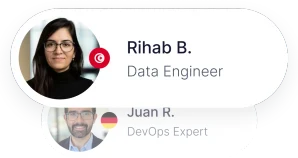
After an average of 2 days, receive a selection of hand-picked, ready-to-work specialists, with direct access to booking a call to interview them.
3

Integrate your new team members in 2 weeks or less. We’ll handle HR and admin, so you don’t lose momentum.
Hire top-tier, vetted talent. Fast.


"I would really recommend working with Proxify when you're building a product, whether that's building a completely new team or scaling an existing one. Proxify has all the right talents for it."


"We can trust Proxify to select good engineers that can help us speed up the process."


"The candidates coming in from Proxify are top-notch individuals."
Skip the resume pile. Our network represents the elite 1% of OpenStack developers worldwide, across 1,000+ tech competencies, with an average of eight years of experience—meticulously vetted and instantly available.

"Quality is at the core of what we do. Our in-depth assessment process ensures that only the top 1% of developers join the Proxify network, so our clients always get the best talent available."
Stoyan Merdzhanov
VP Assessment

Rafael Weiss
Client Engineer


 +40
+40 Takes the time to thoroughly understand your technical challenges. With their expertise, you get the best-fit professionals, ready to solve your toughest challenges on your roadmap, fast.

Matthew Moroni
Client Manager US
Your long-term partner, offering personal support in onboarding, HR and admin to manage your Proxify developers.
With the rise of public cloud adoption, businesses are increasingly seeking ways to balance the scalability and flexibility of cloud services with the need for data privacy, security, and cost efficiency. OpenStack provides a robust platform for building private clouds that seamlessly integrates with public clouds, enabling hybrid cloud strategies.
Thanks to OpenStack's flexibility and robust integration with hypervisors, an OpenStack engineer can simplify the deployment of services across a diverse range of infrastructures. As more organizations look to leverage ARM-based, more cost-effective, and energy-efficient servers, OpenStack enables the easy construction of private clouds on these affordable servers.
Hiring an OpenStack engineer is crucial for companies aiming to take advantage of the growing trend of in-house private cloud solutions. This trend is contributing to a wave of organizations building secure, scalable, and cost-effective cloud infrastructures. With OpenStack expertise, companies can ensure they stay competitive and optimize their cloud environments for the future.
The interconnection between most OpenStack services relies heavily on network configurations. Therefore, it is crucial for an engineer to understand and identify the following network elements:
Linux is the preferred operating system for deploying OpenStack services, making strong Linux expertise essential for engineers. This includes operating, troubleshooting, optimizing, and effectively fine-tuning system configurations and services.
vim or nano.TOML, YAML, and INI.The installation and configuration of OpenStack services heavily rely on shell scripts, Python scripts, and other programming languages. Therefore, proficiency in these skills is highly beneficial for efficiently managing and customizing OpenStack environments.
OpenStack is built on fundamental cloud concepts, making it essential for engineers to understand core principles. The following are the key cloud concepts that every OpenStack engineer must be familiar with:
Storage
Networking
Compute
Orchestration
Security
Monitoring and management
Automation first is the core principle of DevOps. Automation is a core principle of DevOps, making it a crucial skill for streamlining common processes, deployments, and migrations that OpenStack services are likely to encounter. Proficiency in orchestrating these tasks improves efficiency and ensures consistency and reliability across operations.
Like any other, this cloud is built on the principle of distributed services, meaning that all components operate independently. Understanding the key concepts behind this architecture is essential for identifying potential issues or security threats.
This is crucial because monitoring tools are essential for identifying issues and pinpointing their causes within the platform. Below are the key concepts that can have the most significant impact on OpenStack environments.
Experience with AWS, GCP, Azure, etc, is also beneficial.
1. What are the core components of OpenStack, and what are their roles?
Example answer:
2. How does OpenStack handle networking, and what are the key differences between VLAN, VXLAN, and GRE tunneling?
Example answer:
Networking in OpenStack: OpenStack uses Neutron to manage network connectivity between VMs, routers, and external systems. Neutron supports L2 and L3 networking.
3. How would you troubleshoot an instance that cannot connect to the internet in OpenStack?
Example answer:
Steps:
4. Explain creating and attaching block storage to an instance in OpenStack.
Example answer:
instance volume5. What is the difference between OpenStack Heat and Terraform? When would you use one over the other?
Example answer:
Heat: An OpenStack-native orchestration tool that manages resources using YAML templates. Terraform: A multi-cloud orchestration tool that works with different cloud providers using HCL syntax. When to use:
6. How do you manage user authentication and authorization in OpenStack?
Example answer:
OpenStack uses Keystone for identity and access management. Keystone concepts:
7. How does OpenStack integrate with hypervisors? Which hypervisors are supported?
Example answer:
OpenStack Nova provides a hypervisor abstraction layer. Supported hypervisors:
8. What steps are to configure high availability (HA) for OpenStack services?
Example answer:
9. How would you monitor OpenStack services and infrastructure?
Example answer:
10. What are the key differences between object storage (Swift) and block storage (Cinder) in OpenStack? When would you use each? Example answer:
Swift (Object storage):
Cinder (Block storage):
Many companies from various sectors, including universities and research institutions, use OpenStack as a private cloud. It is widely adopted in software development, Big Data processing, and high-performance computing (HPC) use cases, enabling organizations to scale up on demand.
Telecom companies are also increasingly moving to OpenStack due to its seamless integration with existing systems and workflow similar to that of public cloud platforms. This allows them to achieve greater operational efficiency and scalability. This shift enables telcos to adopt hybrid cloud models and maintain flexibility while leveraging cost-effective infrastructure solutions.
The growing demand for AI training and the increasing reliance on big data and data processing further drive the adoption of OpenStack, which offers the scalability and flexibility needed to handle massive datasets and complex computational tasks. More and more organizations are adopting cloud-native architectures to gain greater agility at a lower cost. Thus, mastering OpenStack has become a lucrative skill. In-depth knowledge of OpenStack can help professionals implement and manage cloud solutions.
Due to the complexity of the platform and the high demand in the industry, possessing OpenStack skills can help one secure roles such as cloud architect, systems engineer, and DevOps specialist. There is tremendous career growth potential in the cloud domain with OpenStack expertise.
Using OpenStack provides significant benefits to businesses that rely on infrastructure and technology. Its open-source nature eliminates vendor lock-in and reduces costs by enabling commodity hardware to build private or hybrid clouds.
OpenStack's modular architecture ensures flexibility, allowing businesses to scale resources seamlessly and tailor services like computing, storage, and networking to meet specific workload requirements, such as AI training, big data processing, and high-performance computing (HPC).
With its advanced software-defined networking (SDN) capabilities and integrated storage solutions, OpenStack enhances performance, control, and resource efficiency. Private cloud deployments also improve data security and compliance, making them ideal for industries with stringent regulatory requirements. By leveraging OpenStack, organizations can achieve greater agility, scalability, and cost-effectiveness, empowering them to innovate and optimize their infrastructure to support evolving technological needs.
Hiring a OpenStack developers?
Hand-picked OpenStack experts with proven track records, trusted by global companies.
We work exclusively with top-tier professionals. Our writers and reviewers are carefully vetted industry experts from the Proxify network who ensure every piece of content is precise, relevant, and rooted in deep expertise.

Julio Guerrero
DevOps Engineer
Julio is a DevOps engineer with over 14 years of commercial experience, specializing in cloud technologies such as AWS, GCP, Azure and OpenStack. He has a proven track record in managing and optimizing diverse technical environments and is proficient in SaaS, PaaS, and IaaS models. He currently works as ML Operations Leader, leading a team of six DevOps engineers, overseeing their work, doing code reviews, and mentoring.


Trusted by 2,500 global companies