"I would really recommend working with Proxify when you're building a product, whether that's building a completely new team or scaling an existing one. Proxify has all the right talents for it."

Europe's largest vetted tech talent network
Hire senior and proven Snowflake developers
Stop wasting time and money on bad hires and focus on building great products. We match you with the top 1% of Snowflake freelance developers, consultants, engineers, programmers and experts in days, not months.
ISO 27001
Certified

Hire Snowflake developers fast with Proxify
Proxify has matched Snowflake developers to companies across more than 2,500 engagements worldwide — from early-stage startups to enterprises including Lufthansa, PwC, and Education First. That track record is built on one thing: a vetting process that accepts only around 1% of applicants and a matching process that delivers a 94% success rate.
Every Snowflake developer in our network has cleared five independent rounds of evaluation: AI-powered screening, English assessment, technical assessment, HR and soft skills interview, and a live technical interview with senior engineers. By the time a developer appears in your shortlist, they've already proven they can do the job — not just describe it.
Getting started is straightforward. You share your requirements in a 25-minute call. Within an average of 2 days, you receive a curated selection of hand-picked Snowflake developers matched to your stack, team, and timeline. There's no commitment until you approve a match, and no lock-in after you start. If the engagement goes well, you can transition the developer to your own payroll at any point.
Hire fast with Proxify
Role:
Data Engineering
Type:
Cloud Platform
Current demand:
Low
Proxify rate:
From $33.90/hr
Get matched in 2 days
Hire with 94% match success
Talk to a Snowflake hiring expert today
The ultimate hiring guide: find and hire a top Snowflake Expert
Talented Snowflake developers available now

Carlos N.
Analytics Engineer
Portugal
Trusted member since 2025
6 years of experience
Carlos is an experienced Analytics Engineer with nearly nine years of experience in data architecture, transformation, and analytics engineering.
Expert in

Fares A.
Data Engineer
Egypt
Trusted member since 2024
6 years of experience
Fares is a highly skilled and dedicated Senior Data Engineer renowned for his expertise in designing, developing, and deploying ETL/ELT processes and data warehousing solutions across diverse industries.
Expert in

Antonio S.
Senior Data Engineer
Croatia
Trusted member since 2025
11 years of experience
Antonio is an experienced Senior Data Engineer with over 11 years of expertise in designing and delivering scalable, high-performance data solutions.
Expert in

Marley B.
Data Engineer
Portugal
Trusted member since 2023
7 years of experience
Marley is a Data Engineer with over seven years of commercial experience. He has extensive experience in Python, Apache Spark, SQL and cloud technologies such as AWS and GCP.
Expert in

Angela B.
Senior Data Engineer
North Macedonia
Trusted member since 2025
10 years of experience
Angela is a Senior Data Engineer with over nine years of commercial experience designing and building cloud-based data platforms.
Expert in

Alper B.
Data Engineer
Turkey
Trusted member since 2024
20 years of experience
Alper is a Data Engineer with 20 years of experience, including expertise in SQL Server, Oracle, and cloud data solutions. For the past 5 years, he has specialized as an AWS Data Engineer, utilizing Python, AWS Glue, PySpark, and SQLMesh to design and optimize efficient data pipelines.
Expert in

Iwona K.
Business Intelligence Developer
Poland
Trusted member since 2025
5 years of experience
Iwona is an accomplished Business Intelligence Developer with over five years of experience turning complex data into clear, actionable insights. She specializes in Power BI, Tableau, SQL, and cloud technologies including SAP HANA, Azure, and Microsoft Fabric, delivering data-driven solutions for clients across the US and Europe.
Expert in

Fabio C.
Senior Data Engineer
Spain
Trusted member since 2025
8 years of experience
Fabio is a seasoned Data Engineer with over seven years of experience delivering scalable, high-performance data solutions across the fintech, edtech, proptech, and q-commerce sectors. Known for his analytical mindset and pragmatic approach, he has led strategic initiatives in data ingestion, cost optimization, and infrastructure as code.
Expert in

Ivan P.
Data Engineer
North Macedonia
Trusted member since 2025
10 years of experience
Ivan is an experienced Data Engineer with over 10 years of commercial experience in software development and data-driven solutions. He has deep expertise in AWS cloud services, Kafka, Snowflake, and Airflow, combined with strong programming skills in Java, Scala, and Python.
Expert in

Mohamed K.
Data Engineer
Egypt
Trusted member since 2024
5 years of experience
Mohamed is a skilled Data Engineer with expertise in building data pipelines, real-time systems, and cloud orchestration. Proficient in technologies such as BigQuery, Snowflake, dbt, Kubernetes, Kafka, and Airflow, he consistently delivers efficient, scalable, and high-performing solutions.
Expert in
Carlos N.
Analytics Engineer
Portugal
Trusted member since 2025
6 years of experience
Carlos is an experienced Analytics Engineer with nearly nine years of experience in data architecture, transformation, and analytics engineering.
Expert in
Snowflake
Microsoft Power BI
SQL
Python
AWS S3
The ultimate hiring guide: find and hire a top Snowflake Expert
Three steps to your perfect Snowflake developer
We combine the best of AI-technology and our team’s deep expertise to deliver hand-picked talent in just a few days.
Get started in just three simple steps.
1
Book a meeting

Share your unique context with us over a 25-minute call, so we can match you with the perfect candidates for your needs.
2
Review your matches
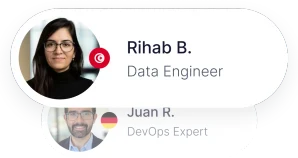
After an average of 2 days, receive a selection of hand-picked, ready-to-work specialists, with direct access to booking a call to interview them.
3
Start working together
Integrate your new team members in 2 weeks or less. We’ll handle HR and admin, so you don’t lose momentum.
Find Snowflake developers
Hire top-tier, vetted talent. Fast.
Why clients trust Proxify


"We can trust Proxify to select good engineers that can help us speed up the process."


"The candidates coming in from Proxify are top-notch individuals."
Only senior professionals, extensively vetted
Skip the resume pile. Our network represents the elite 1% of Snowflake developers worldwide, across 1,000+ tech competencies, with an average of eight years of experience—meticulously vetted and instantly available.
Application process
Our vetting process is one of the most rigorous in the industry. Over 20,000 developers apply each month to join our network, but only about 1% make it through. When a candidate applies, they’re evaluated through our Applicant Tracking System. We consider factors like years of experience, tech stack, rates, location, and English proficiency.
Screening interview
The candidates meet with one of our recruiters for an intro interview. This is where we dig into their English proficiency, soft skills, technical abilities, motivation, rates, and availability. We also consider our supply-demand ratio for their specific skill set, adjusting our expectations based on how in-demand their skills are.
Assessment
Next up, the candidate receives an assessment; this test focuses on real-world coding challenges and bug fixing, with a time limit to assess how they perform under pressure. It’s designed to reflect the kind of work they’ll be doing with clients, ensuring they have the necessary expertise.
Live coding
Candidates who pass the assessment move on to a technical interview. This interview includes live coding exercises with our senior engineers, during which they're presented with problems and need to find the best solutions on the spot. It’s a deep dive into their technical skills, problem-solving abilities, and thinking through complex issues.
Proxify member
When the candidate impresses in all the previous steps, they’re invited to join the Proxify network.

"Quality is at the core of what we do. Our in-depth assessment process ensures that only the top 1% of developers join the Proxify network, so our clients always get the best talent available."
Stoyan Merdzhanov
VP Assessment
Meet your dedicated dream team

Rafael Weiss
Client Engineer


 +40
+40 Takes the time to thoroughly understand your technical challenges. With their expertise, you get the best-fit professionals, ready to solve your toughest challenges on your roadmap, fast.

Matthew Moroni
Client Manager US
Your long-term partner, offering personal support in onboarding, HR and admin to manage your Proxify developers.
Hire the best Snowflake Developers in 2026
Introduction to Snowflake
As businesses increasingly move their data and operations to the cloud, platforms like Snowflake have emerged as critical tools for managing large volumes of data efficiently and cost-effectively. With its innovative architecture and strong structured and semi-structured data support, Snowflake has become one of the most popular cloud-based data platforms.
Introduction to Snowflake
Snowflake is a cloud-based data storage, processing, and analytics platform. What distinguishes Snowflake is its unique architecture that separates computing and storage, allowing each to scale independently. This provides organizations with great flexibility in terms of performance and cost management. Snowflake is also well-suited for handling both structured and semi-structured data formats, such as JSON, Avro, and Parquet, making it a versatile solution for various data use cases.
Snowflake has become a competitive skill because it allows organizations to scale their data operations effortlessly without worrying about hardware, infrastructure, or traditional data warehouse limitations. It’s a widely adopted platform, and organizations in the finance and healthcare industries highly value knowledge of Snowflake.
Professionals skilled in Snowflake are sought after for their ability to enable faster decision-making, improve business intelligence, and drive innovation through data. Companies are increasingly choosing Snowflake because it offers low operational overhead, simplifies data management, and enables seamless team collaboration.
Must-have technical skills
When hiring a Snowflake developer, you must look for proficiency in core technical skills essential to work efficiently on the platform. Here are the most important skills:
1. Advanced SQL skills
SQL is the primary language used in Snowflake. A professional Snowflake developer should be able to write efficient queries, use advanced functions, and optimize query performance. Proficiency in writing complex joins, window functions, and working with large datasets is essential.
2. Snowflake architecture and design
A solid understanding of Snowflake's architecture - such as its multi-cluster, multi-tenant design, how compute and storage are separated, and the use of virtual warehouses is essential. Developers should know how to configure, optimize, and scale virtual warehouses.
3. Data modeling
Expertise in creating effective data models (star schema, snowflake schema, etc.) is essential for Snowflake developers. Data modeling is key to organizing large datasets for efficient querying and reporting.
4. ETL/ELT skills
A Snowflake developer must be skilled in data integration processes, especially ETL (Extract, Transform, Load) or ELT (Extract, Load, Transform). Familiarity with third-party tools (e.g., Talend, Apache NiFi, Fivetran, Snaplogic) and Snowflake's native tools like Snowpipe is important for automating data loads.
5. Performance tuning
Snowflake developers must be able to optimize queries and database performance. This involves understanding clustering, partitioning strategies, and resource management. Familiarity with Snowflake's query profiling and monitoring tools is crucial.
6. Cloud platform knowledge
Snowflake runs on top of cloud services like AWS, Azure, or Google Cloud. Developers must be familiar with the underlying cloud platform’s storage, networking, and security features to fully optimize and integrate Snowflake.
7. Security & data governance
Security is a key consideration in Snowflake, especially when dealing with sensitive data. Knowledge of role-based access control (RBAC), data encryption, and Snowflake’s sharing and data access controls is critical for ensuring secure data management.
Nice-to-have technical skills
While the must-have technical skills are essential, certain additional skills will make a developer stand out and bring added value to your organization:
1. Programming languages (Python, Java, etc.)
A Snowflake developer with knowledge of languages like Python or Java can write scripts to automate processes, integrate Snowflake with other tools, or build custom applications on top of the data platform.
2. Data Visualization tools
Experience with data visualization tools such as Tableau, Power BI, etc, is a plus. Snowflake integrates seamlessly with these tools, so developers who can also assist in presenting data to non-technical stakeholders are highly valuable.
3. Machine Learning and Data Science
Snowflake is increasingly used in machine learning workflows. Knowledge of ML frameworks (e.g., TensorFlow, PyTorch) and integrating them with Snowflake for predictive analytics or artificial intelligence can be an asset, particularly in industries like finance and healthcare.
4. Serverless Computing and Data Lakes
Knowledge of serverless architectures and working with data lakes (especially integrating Snowflake with platforms like AWS S3) is a bonus, as these are becoming increasingly common in modern data stacks.
5. Snowflake certifications
Snowflake offers various certifications (e.g., Snowflake Certified Data Engineer, Snowflake Certified Architect) to validate a developer's expertise. Candidates with certifications stand out as they better understand Snowflake’s functionality and best practices.
Interview questions and expected answers
1. What is the Snowflake architecture, and how does it differ from traditional data warehouses?
Expected answer: The candidate should explain the multi-layered architecture, including storage, compute, and services layers, and how they scale independently. They should highlight the decoupling of compute and storage and the ability to scale elastically.
2. How does Snowflake handle semi-structured data?
Expected answer: Snowflake uses the VARIANT data type to handle semi-structured data (e.g., JSON, Avro, Parquet) without predefining a schema, making it easy to ingest and analyze.
3. Explain how Snowpipe works in Snowflake.
Expected answer: Snowpipe is a service that loads data in real-time into Snowflake from cloud storage. It automates the data ingestion process and is triggered automatically by file arrivals.
4. What are clustering keys, and how do they impact performance?
Expected answer: Clustering keys define how data is stored on disk in Snowflake. By choosing appropriate clustering keys, developers can reduce the cost and time of queries that filter on those keys.
5. What is Time Travel, and how would you use it?
Expected answer: Time Travel allows users to query historical data for a set period, typically 1 to 90 days, which is useful for data recovery, auditing, and undoing accidental changes.
6. What is Zero-Copy Cloning in Snowflake?
Expected answer: Zero-Copy Cloning allows users to create a copy of a database, schema, or table without duplicating the underlying data, which is space-efficient and fast.
7. How do you optimize query performance in Snowflake?
Expected answer: Candidates should mention techniques like query profiling, using materialized views, clustering keys, and minimizing data scans through proper partitioning.
8. Can you explain how Snowflake scales with compute and storage?
Expected answer: Snowflake’s architecture allows independent scaling of compute and storage resources, so businesses can scale compute power when needed without affecting storage costs.
9. How do you implement role-based access control (RBAC) in Snowflake?
Expected answer: The candidate should describe how RBAC is used to define and control user access at the database, schema, table, and column level, ensuring secure data access.
10. How does Snowflake handle concurrency and manage workloads?
Expected answer: Snowflake uses multi-cluster virtual warehouses to handle concurrent workloads. These clusters can auto-scale to ensure consistent performance, even under high user load.
11. How would you load data from an external source to Snowflake?
Expected answer: The candidate should discuss tools like Snowpipe, staging tables, or third-party ETL tools (e.g., Fivetran) to load data into Snowflake.
12. What are the benefits of Snowflake’s multi-cloud architecture?
Expected answer: The candidate should mention that Snowflake supports deployment on AWS, Azure, and Google Cloud, offering flexibility in cloud choice, disaster recovery, and data sovereignty.
Industries and applications
Snowflake’s flexibility and scalability make it a strong choice for various industries. Below are key sectors where Snowflake is being leveraged:
1. Retail and eCommerce
Retailers and eCommerce platforms use Snowflake to analyze customer purchasing behavior, optimize supply chains, and deliver personalized experiences. Snowflake's ability to process large datasets and support real-time analytics is crucial for providing dynamic pricing, inventory tracking, and consumer insights.
2. Financial services
Snowflake helps with real-time transaction processing, fraud detection, risk management, and regulatory compliance in the financial sector. Its security features and ability to handle large, complex datasets make it ideal for financial institutions that rely on real-time insights to stay competitive.
3. Healthcare
Snowflake allows healthcare organizations to store, analyze, and share large clinical and operational data volumes. Its ability to integrate data from multiple sources (like electronic health records, medical devices, and clinical trials) facilitates data-driven decision-making and enhances patient care while complying with regulations.
4. Technology & SaaS
Technology companies use Snowflake to manage vast amounts of operational and usage data, monitor application performance, and conduct A/B testing for product optimization. The platform’s cloud-native architecture integrates seamlessly with other services like AWS, Azure, and Google Cloud.
5. Media & Entertainment
Media companies use Snowflake to analyze user behavior, track content consumption patterns, and optimize advertising strategies. With the ability to handle large amounts of media data and run high-performance analytics, Snowflake helps businesses make data-driven decisions to enhance content delivery.
6. Manufacturing
Snowflake enables predictive maintenance, supply chain optimization, and process improvement in manufacturing by analyzing data from sensors, production systems, and quality control measures. Snowflake's ability to scale with real-time IoT data makes it a powerful tool for manufacturers seeking to innovate.
Summary
Snowflake is a highly sought-after skill due to its cloud-native design, scalability, and ability to handle both structured and semi-structured data. Developers skilled in Snowflake architecture, SQL, data modeling, ETL processes, and performance optimization are in high demand.
While technical expertise is critical, additional skills such as experience with data visualization tools or machine learning frameworks can set top candidates apart. The interview process should focus on assessing core competencies related to Snowflake’s unique features, cloud integration, and performance tuning.
Hiring the right Snowflake professional ensures your organization can leverage cutting-edge data infrastructure to drive business growth, innovation, and decision-making.
Hiring a Snowflake developers?
Find Snowflake developers
Hand-picked Snowflake experts with proven track records, trusted by global companies.
Verified author
We work exclusively with top-tier professionals. Our writers and reviewers are carefully vetted industry experts from the Proxify network who ensure every piece of content is precise, relevant, and rooted in deep expertise.

Rama Krishna Rao
Data Engineer and Data Scientist
Rama is a Data Expert with over ten years of commercial experience. He has strong programming skills in SQL, Python, and R and experience in data visualization tools like Power BI and Tableau. He also has experience in developing solutions using Office 365 apps, including SharePoint, Power App, Flow, Planner, Power Automate, etc.
Related articles
Have a question about hiring a Snowflake developer?
Explore more skills
Role
Software product engineering
Data and artificial Intelligence
Cloud and infrastructure
Quality Assurance
Design
Trusted by 2,500 global companies