"I would really recommend working with Proxify when you're building a product, whether that's building a completely new team or scaling an existing one. Proxify has all the right talents for it."


Stop wasting time and money on bad hires and focus on building great products. We match you with the top 1% of ETL freelance developers, consultants, engineers, programmers and experts in days, not months.
ISO 27001
Certified

Proxify helps companies hire vetted ETL developers quickly and with less risk. We have matched tech professionals with startups and global enterprises such as Lufthansa, PwC, and Education First, among others. Only around 1% of applicants join our network, and 94% of introduced candidates are successfully matched.
Every ETL developer completes five vetting stages, including AI-powered screening, English and technical assessments, a soft skills interview, and a live technical interview with senior engineers.
After a 25-minute discovery call, you receive a hand-picked shortlist of ETL developers within an average of 2 days. There is no commitment until you approve a match, no long-term lock-in, and the option to move the developer to your own payroll.
Hire fast with Proxify
The ultimate hiring guide: find and hire a top ETL Expert

Data Engineer
Ali is a talented Data Engineer with seven years of experience. He worked in various fields, such as insurance, governmental projects and cloud systems.
Expert in

Data Engineer
Zakaria is a skilled Data Engineer with six years of experience in IT, railways, and healthcare industries.
Expert in

Data Engineer
Felipe is a Data Engineer with over 12 years of experience in IT.
Expert in

Data Engineer
Ahmed boasts over 13 years of extensive experience as a Data Analytics and Business Intelligence professional specializing in data analysis and visualization.
Expert in

Data Engineer
Gopal is a Data Engineer with over eight years of experience in regulated sectors like automotive, technology, and energy. He excels in GCP, Azure, AWS, and Snowflake, with expertise in full life cycle development, data modeling, database architecture, and performance optimization.
Expert in

Data Engineer
Dean is a data engineer with five years of commercial experience. His primary expertise lies in designing, building, and maintaining robust data pipelines and infrastructure.
Expert in

Data Engineer
Rihab is a Data Engineer with over 7 years of experience working in regulated industries such as retail, energy, and fintech. She has strong technical expertise in Python and AWS, with additional skills in Scala, data services, and cloud solutions.
Expert in

Senior BI Developer
Cristian is a seasoned BI developer with over 20 years of experience delivering reliable, end-to-end reporting and analytics solutions. His technical toolkit includes Power BI, SQL, SSIS, and Azure Data Factory, and he has worked extensively across the banking, media, and SaaS sectors.
Expert in
Data Engineer
Ali is a talented Data Engineer with seven years of experience. He worked in various fields, such as insurance, governmental projects and cloud systems.
Expert in
The ultimate hiring guide: find and hire a top ETL Expert
We combine the best of AI-technology and our team’s deep expertise to deliver hand-picked talent in just a few days.
Get started in just three simple steps.
1

Share your unique context with us over a 25-minute call, so we can match you with the perfect candidates for your needs.
2
After an average of 2 days, receive a selection of hand-picked, ready-to-work specialists, with direct access to booking a call to interview them.
3
Integrate your new team members in 2 weeks or less. We’ll handle HR and admin, so you don’t lose momentum.
Hire top-tier, vetted talent. Fast.


"I would really recommend working with Proxify when you're building a product, whether that's building a completely new team or scaling an existing one. Proxify has all the right talents for it."


"We can trust Proxify to select good engineers that can help us speed up the process."


"The candidates coming in from Proxify are top-notch individuals."
Skip the resume pile. Our network represents the elite 1% of ETL developers worldwide, across 1,000+ tech competencies, with an average of eight years of experience—meticulously vetted and instantly available.

"Quality is at the core of what we do. Our in-depth assessment process ensures that only the top 1% of developers join the Proxify network, so our clients always get the best talent available."
Stoyan Merdzhanov
VP Assessment

Rafael Weiss
Client Engineer


 +40
+40 Takes the time to thoroughly understand your technical challenges. With their expertise, you get the best-fit professionals, ready to solve your toughest challenges on your roadmap, fast.

Matthew Moroni
Client Manager US
Your long-term partner, offering personal support in onboarding, HR and admin to manage your Proxify developers.
ETL developers build the pipelines that move and transform raw data into usable formats for business intelligence, analytics, and machine learning. This guide walks you through everything you need to know to hire top ETL talent who will help your organization leverage data effectively.
ETL development is at the heart of data engineering. It involves extracting data from various sources, transforming it to meet business needs, and loading it into a storage solution like a data warehouse or a data lake.
Today's ETL developers work with tools like Apache Airflow, Talend, Informatica, Azure Data Factory, and dbt (data build tool). They often code in SQL, Python, or Java, and increasingly use cloud-based services from AWS, Azure, and Google Cloud.
An experienced ETL developer not only ensures that data is reliably moved but also that it is clean, optimized, and ready for downstream use cases such as dashboards, reporting, and predictive modeling.
While ETL (Extract, Transform, Load) and ELT (Extract, Load, Transform) serve similar purposes in data integration, the order of operations and ideal use cases differ significantly. In traditional ETL workflows, data is transformed before it’s loaded into the destination system—ideal for on-premise environments and when transformations are complex or sensitive.
ELT, on the other hand, flips this order by first loading raw data into a target system—usually a modern cloud data warehouse like Snowflake, BigQuery, or Redshift—and then transforming it in place.
This approach leverages the scalable compute power of cloud platforms to handle large datasets more efficiently and simplifies pipeline architecture. Choosing between ETL and ELT often comes down to infrastructure, data volume, and specific business requirements.
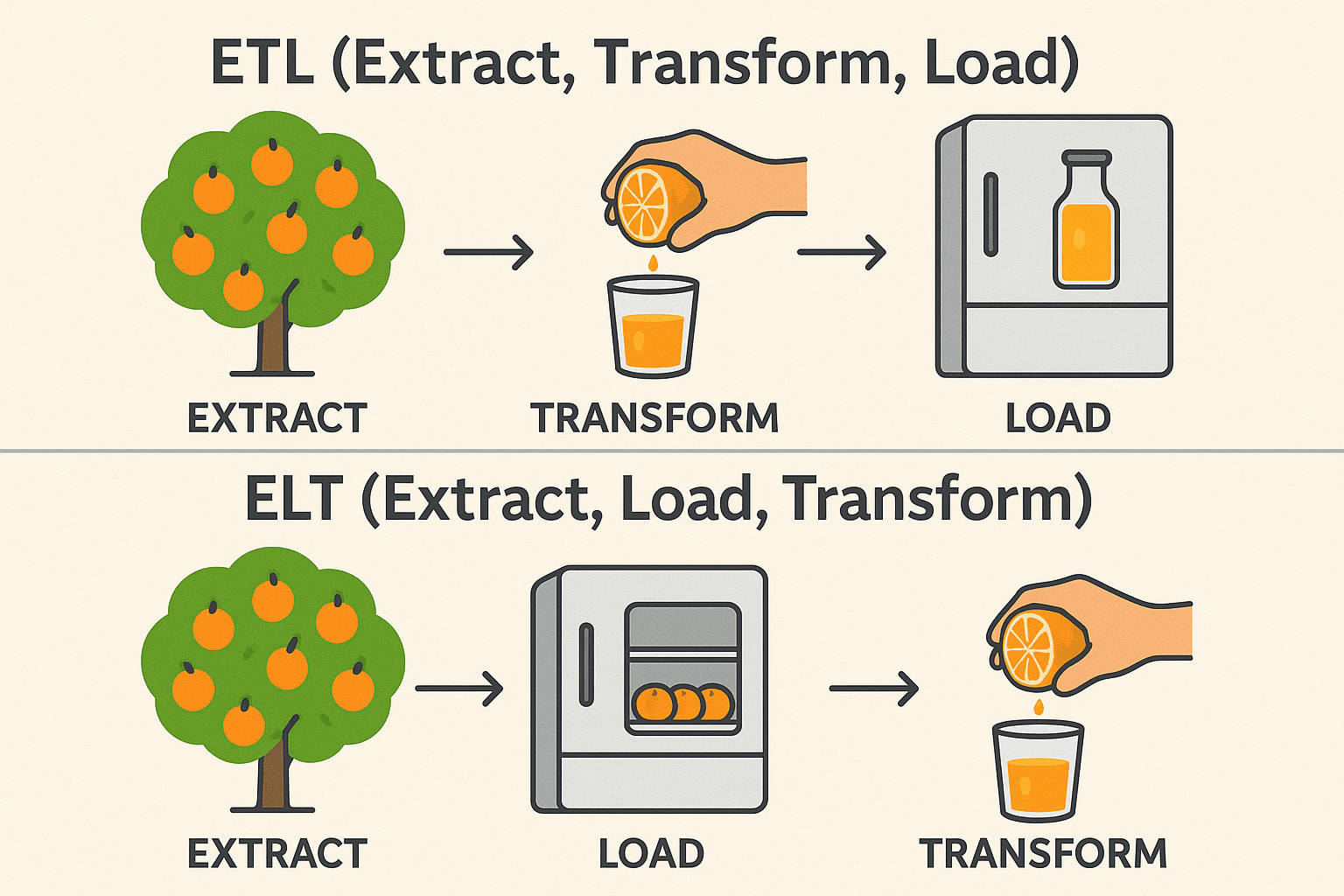
ETL (Extract → Transform → Load)
Extract: Pick oranges from the tree (Collect raw data from databases, APIs, or files). Transform: Squeeze them into juice before storing (Clean, filter, and format the data). Load: Store the ready-made juice in the fridge (Save structured data in a data warehouse). Commonly used in: Finance & Healthcare (Data must be clean before storage).
ELT (Extract → Load → Transform)
Extract: Pick oranges from the tree (Collect raw data from databases, APIs, or files). Load: Store the whole oranges in the fridge first (Save raw data in a data lake or cloud warehouse). Transform: Make juice when needed (Process and analyze data later). Commonly used in: Big Data & Cloud (Faster, scalable transformations). Tech stack: Snowflake, BigQuery, Databricks, AWS Redshift.
ETL developers are indispensable across multiple industries, including:
No matter the industry, businesses increasingly rely on accurate, timely data, making skilled ETL developers a critical asset.
When hiring an ETL developer, prioritize candidates who demonstrate these core skills:
A top-tier ETL developer also writes clear, maintainable code and understands the principles of data governance and security.
While not mandatory, the following skills can set great ETL developers apart:
These additional capabilities can provide significant value as your data needs grow more sophisticated.
Here are some thoughtful questions to help you assess candidates:
1. Can you describe the most complex ETL pipeline you’ve built?
Look for: Size of datasets, number of transformations, error handling strategies.
Sample answer: I built a pipeline that extracted user event data from multiple apps, cleaned and joined the data, enriched it with third-party information, and loaded it into Redshift. I optimized load performance by partitioning data and used AWS Glue for orchestration.
2. How do you ensure data quality throughout the ETL process?
Look for: Data validation methods, reconciliation steps, error logging.
Sample answer: I implement checkpoints at each stage, use data profiling tools, log anomalies automatically, and set up alerts for thresholds being breached.
3. How would you optimize an ETL job that’s running too slowly?
Look for: Partitioning, parallel processing, query optimization, and hardware tuning.
Sample answer: I start by analyzing query execution plans, then refactor transformations for efficiency, introduce incremental loads, and if necessary, scale up compute resources.
4. How do you handle schema changes in source data?
Look for: Strategies for adaptability and robustness.
Sample answer: I build schema validation into the pipeline, use version control for schema updates, and design ETL jobs to adapt dynamically or fail gracefully with alerts.
5. What’s your experience with cloud-based ETL tools?
Look for: Practical experience rather than just theoretical knowledge.
Sample answer: I've used AWS Glue and Azure Data Factory extensively, designing serverless pipelines and leveraging native integrations with storage and compute services.
6. How would you design an ETL process to handle both full loads and incremental loads?
Sample answer: For full loads, I design the ETL to truncate and reload the target tables, suitable for small to medium datasets. For incremental loads, I implement change data capture (CDC) mechanisms, either via timestamps, version numbers, or database triggers. For example, in a PostgreSQL setup, I might leverage logical replication slots to pull only the changed rows since the last sync.
7. What steps would you take to troubleshoot a data pipeline that intermittently fails?
Sample answer: First, I review the pipeline logs to detect patterns, such as time-based failures or data anomalies. Then, I isolate the failing task—if it's a transformation step, I'll re-run it with sample data locally. I often set up retries with exponential backoff, and alerts via tools like PagerDuty to ensure a timely response to failures.
8. Can you explain the differences between batch processing and real-time processing, and when you would choose one over the other?
Sample answer: Batch processing involves collecting data over time and processing it in bulk, perfect for reporting systems that don't need real-time insights, like end-of-day sales reports. Real-time processing, using technologies like Apache Kafka or AWS Kinesis, is critical for use cases like fraud detection or recommendation engines where milliseconds matter.
9. How do you manage dependencies between multiple ETL jobs?
Sample answer: I use orchestration tools like Apache Airflow, where I define Directed Acyclic Graphs (DAGs) to express job dependencies. For instance, a DAG might specify that the 'extract' task must complete before 'transform' begins. I also use Airflow’s sensor mechanisms to wait for external triggers or upstream data availability.
10. In a cloud environment, how would you secure sensitive data during the ETL process?
Sample answer: I encrypt data both at rest and in transit, using tools like AWS KMS for encryption keys. I enforce strict IAM policies, ensuring that only authorized ETL jobs and services can access sensitive data. In pipelines, I mask or tokenize sensitive fields like PII (Personally Identifiable Information) and maintain detailed audit logs to monitor access and usage.
Hiring an ETL developer is about more than just finding someone who can move data from point A to point B. It's about finding a professional who understands the nuances of data quality, performance, and evolving business needs. Look for candidates with a strong technical foundation, practical experience with modern tools, and a proactive approach to problem-solving. Ideally, your new ETL developer will not only maintain your data flows but also continuously improve them, ensuring your organization’s data is always trustworthy, scalable, and ready for action.
Hiring a ETL developers?
Hand-picked ETL experts with proven track records, trusted by global companies.
We work exclusively with top-tier professionals. Our writers and reviewers are carefully vetted industry experts from the Proxify network who ensure every piece of content is precise, relevant, and rooted in deep expertise.

Jerome Pillay
Business Intelligence Consultant & Data Engineer
Jerome is a seasoned Business Intelligence Consultant with a proven track record in the management consulting industry. He brings expertise in Statistical Data Analysis, Databases, Data Warehousing, Data Science, and Business Intelligence, leveraging his skills to deliver actionable insights and drive data-informed decision-making. A highly skilled IT professional, Jerome holds a Bachelor’s Degree in Computer Science from the University of KwaZulu-Natal.


Trusted by 2,500 global companies