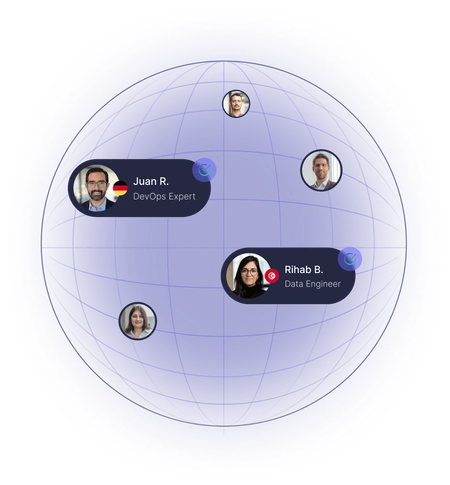


At this point, it’s no secret that online talent marketplaces have become a bit of a mixed bag. Proxify operates differently from traditional freelance platforms as a vetted talent network designed for long-term, in-house-style integration. First of all, there is too much information and contradictory advice that, if you’re not careful, might send you in the wrong direction as far as hiring software developers is concerned.
Some of the other platforms may offer a more direct approach, but the sheer number of freelancers that sign up poses a different problem altogether. Mainly, it becomes increasingly harder to craft a good proposal, find the right fit, and start the job with clear expectations in mind (including deadlines, task quality, turnaround time, milestones, and more).
Still, there is considerable work to do if you want to find a quality developer who will stick with your company in the long term.
In that light, here’s a list of the most prominent online marketplaces, their pros and cons, as well as the best approach to get the most out of each one.
Key takeaways
Proxify: Best for high-quality, pre-vetted developers (top 1%) with competitive pricing and a risk-free trial.
Toptal: High-end talent with a rigorous 3% acceptance rate, but requires a $500 deposit and has the highest hourly rates.
Upwork: The largest global talent pool; requires significant time for manual screening and navigating a competitive bidding system.
Fiverr: Ideal for small, task-based "gigs" rather than long-term technical partnerships.
PeoplePerHour:A budget-friendly alternative that requires careful candidate vetting due to mixed service quality.
Platform | Vetting process | Best for | Pricing model |
|---|---|---|---|
Proxify | Top 1% (Pre-vetted) | Elite developers, long-term scale | Competitive / Mid-range |
Toptal | Top 3% (Pre-vetted) | High-budget, senior expertise | Premium ($60-$250/hr) |
Upwork | Self-service / Bidding | General projects, all budgets | Variable (Freelancer set) |
Fiverr | Portfolio-based | Quick tasks, small gigs | Fixed price per gig |
Fiverr
Fiverr has a very interesting (and I’d argue, relatively novel) hiring model. Each freelancer on the platform offers “gigs” starting at $5 per hour, depending on the complexity of the task.
You can pick from categories such as graphic design, writing, web development, audio talent, sales, video production, and a plethora of other services that cover pretty much everything under the sun.
Meanwhile, freelancers are setting their own packages, prices, and turnaround times as well. Fiverr is free to use both for employers and freelancers, but for each successfully completed task, the platform keeps 20% of the transaction.
How to hire on Fiverr:
Go to the home page and select your preferred category or job type
Scroll through the list of freelancers and pick the gig that best suits your needs
Choose any extra options related to the gig and finalize your payment
The freelancer will contact you directly afterward to start working on your task
Pros:
You can browse through thousands of relevant freelancers (and their respective gigs) by typing in your preferred keywords
You can compare the packages on each freelancer’s profile
The platform offers support if there is a problem with the order
There is a variety of pricing options, as the prices are set by the freelancers themselves
Fiverr doesn’t release your payment until the order is completed
Cons:
You have to invest ample amounts of time to find the right freelancer and the right gig for your needs
There are limited options for price negotiation unless you decide to go with a custom gig
Besides leaving an unsatisfactory review, there’s not much else you can do if you’re not satisfied with the service
Bottom line: Fiverr can be a hit-and-miss, as the entirety of the experience rests on the off chance of finding a freelancer who is qualified enough to complete the entirety of your task from beginning to end. That is, without any major hiccups.
It’s a good site if you have the time and can invest in finding someone who can get the job done.
Otherwise, the pool of freelancers is too big and diluted to find a professional capable of a serious part-time or full-time commitment.
Upwork
Currently, Upwork is the largest online freelance marketplace in the world, with more than 18 million freelancers across a variety of industries and professions.
Upwork works differently compared to Fiverr. On Upwork, employers can post job/project descriptions, and freelancers bid on the posts, offering their services to employers.
In a sense, freelancers compete with one another, and the employer chooses the best professional for the task.
In my personal experience working on Upwork, I’ve been on both ends of the hiring side with some mixed success over the years.
As a freelancer, I’ve been able to bid on and win many medium- to high-paying projects (in relative terms), but the competition for each one has been as fierce as it gets.
As part of a hiring account, I’ve had mostly positive experiences and have found truly talented professionals who’ve gone above and beyond the job description to deliver the best service within the agreed turnaround time.
How to hire on Upwork:
Navigate to the home page and click on “Find Talent.”
Click on “Post a job”, select your category, project length, and required skills
Pick between an “hourly rate” or “fixed budget.”
Write your job description
Review the draft, make changes as required, and post the project
You should receive your first bids shortly after that; screen the talent and pick the professional you think will be the best fit for the job
Pros:
Authority brands such as Microsoft, Airbnb, and Samsung have all used Upwork to find top-notch professionals
Upwork features 5K skills and more than 70 categories to respond to a wide range of project needs
The workforce comes from more than 180 countries all around the globe
It features a tried-and-tested escrow system to easily handle payments, milestones, and task deliveries all within the platform itself
There are multiple options to choose from, including free and paid job posts
Cons:
Some quality freelancers may choose other platforms because of the high commissions based on their earnings on the site
Freelancers aren’t able to search for employers, which makes it difficult for job seekers and puts them at a disadvantage
There are a lot of users on the site, which can be a detriment for employers who need to make a hire immediately
Bottom line: Upwork is good for people who have experience using the platform. However, in order to become the most efficient at candidate screening on the site, you’d have to spend at least 2-3 weeks learning how everything works and what to avoid as well.
Also, picking the wrong candidate for the job can be even more costly than hiring them through traditional channels, especially for long-term tasks.
PeoplePerHour
PeoplePerHour was founded in 2007 and currently has more than 2M freelancers on the platform from all over the world.
The marketplace offers free access to all freelance profiles (with some exceptions), matches professionals to jobs, and handles payments.
PPH also differentiates itself from the former two platforms regarding account upgrades and additional requests. For example, it charges $34 to request an NDA (non-disclosure agreement) and $60 for a talent scout project upgrade, in addition to the usual fees ($20 to feature your project and $15 to post an “urgent” listing).
How to hire on PeoplePerHour:
Click on “Sign Up” and create your account
Create your project, choose a category, and write the job description
Choose a budget for your project
Post your project and choose any preferred additional upgrades, including increased exposure or marking it as “urgent”
Complete the payment to finalize your listing
Screen the freelancers that applied to your project and choose one (or more) professionals to start working on it
Pros:
Employers have full access to detailed freelancer profiles
All freelancers are vetted before creating a profile on the platform
Projects can be featured for free
Features a reliable escrow system that keeps the funds in it until both parties agree on a successful project completion
It offers a video chat option
Cons:
There is no phone or live chat support, only email
Some resumés are in PDF format and are downloaded immediately without any prompts
Some users have argued that freelancers aren’t as professional, and there is minimal support to resolve this issue
Bottom line: Compared to the other four entries on this list, PPH has the least favorable reputation out of all of them. However, it’s also one of the cheapest options pertaining to long-term projects.
However, employers should be very careful in screening potential candidates. This has been proven to be the crucial step in hiring freelancers on PeoplePerHour that can make or break your project.
Toptal
Toptal is an online platform where you can find freelancers proficient in a wide range of categories, including software developers, project managers, finance professionals, and more.
The platform has a very rigorous screening process, accepting only 3% of all freelancer applications each year.
Toptal has the priciest offers of everyone on this list. Their hourly rates range from $60 to $250 per hour for a single professional. Additionally, employers must make a mandatory $500 deposit that will be applied to their first-hire credit. If you don’t want to proceed with the hiring process, the deposit will be fully refunded to you.
How to hire on Toptal:
Click on the “Hire top talent” button found on the homepage
Choose the role that you’d like to hire for and follow the instructions by clicking “Next” after completing each prompt
The platform will find a suitable freelancer for your project; meanwhile, a Toptal expert will connect with you to guide you through the hiring process
Pros:
Senior experts perform the candidate matching service
There is a rigorous screening process that tests applicants with a variety of both soft and hard skill assessments
You can choose to work with multiple candidates before choosing an expert
The platform offers freelancers from more than 100 countries, mainly from Europe and the Americas
Cons:
You can’t use filters to search for candidates
There is no freelancer database to search through resumés in order to find the right fit
It’s the most expensive platform to use on this list
Bottom line: Toptal has a very good reputation, but the pricing is also reflected in this fact. It’s the most expensive option compared to the other four platforms, and it requires a $500 deposit before you start the hiring process.
Proxify
Proxify is a network of pre-vetted, elite software developers and independent tech experts that sources top talent for clients in multiple industries, including finance, solar energy, health, games, legal, and more.
Through an extensive screening process, Proxify accepts only the top 1% of developers on the platform. This ensures clients receive premium-quality developers from day one.
The platform offers competitive pricing for proven talent with multiple years of real-world experience across a variety of stacks, including:
...and tons more!
Pros:
Competitive pricing that delivers exceptional value compared to other premium platforms
A one-week risk-free trial period allows clients to evaluate the developer fit before committing financially
Comprehensive dashboard provides centralized control over team management, time tracking, vacation scheduling, payments, and direct access to customer success support
Fast matching process connects clients with ideal developers within days
Rigorous screening process ensures only extensively vetted, thoroughly tested developers join the platform
Dedicated client management team provides responsive support to address and resolve inquiries promptly
Cons:
Currently expanding market presence and global visibility
Bottom line: Proxify stands out as a top-tier talent network for long-term engagements, offering:
Cost efficiency: Competitively priced compared to premium alternatives without compromising quality
Speed: Rapid matching with pre-vetted talent in just a few days
Flexibility: Comprehensive dashboard for seamless management of payments, time reports, and team scaling
Quality assurance:Risk-free trial period and top 1% acceptance rate guarantee exceptional talent
Conclusion: Why Proxify leads the pack
When comparing all five platforms, Proxify emerges as the most favorable option for companies seeking reliable, high-quality software developers. While Toptal offers rigorous vetting, its premium pricing and mandatory deposit create barriers to entry. Upwork and Fiverr provide vast talent pools but require significant time investment in screening and carry higher risks of mismatched hires. PeoplePerHour offers budget-friendly options, but the quality is inconsistent.
Proxify strikes the optimal balance: combining rigorous vetting (top 1% acceptance rate) with competitive pricing, a risk-free trial period, and rapid matching. The platform eliminates the time-consuming screening process inherent to marketplaces like Upwork while maintaining cost efficiency, making premium talent accessible to companies seeking reliable, long-term developer partnerships. For companies prioritizing quality, speed, and value in their developer hiring process, Proxify represents the clear choice.