

João M.
Deep Learning Research Engineer
Han är specialiserad på att bygga avancerade modeller, inklusive stora språkmodeller (LLM), kapabel till kodrefactoring, feldetektering och kontinuerlig inlärning. João arbetar mycket med PyTorch och distribuerar modeller på molnplattformar och högpresterande datorsystem.
Innan ASML ledde han forskargrupper vid GAIPS Lab, publicerade i ledande AI-konferenser, och säkrade bidrag från USA Flygvapnet och FCT. Han undervisade också i AI-kurser, han fick ett pedagogiskt excellenspris för sina bidrag till utbildningen.
João spetsprojekt omfattar fortlöpande inlärningsteknik, vilket gör det möjligt för AI att förvärva ny kunskap utan att glömma tidigare uppgifter, och tillämpa förstärkning lära sig att träna modeller mer effektivt med mindre data. Han brinner för att göra AI-system mer effektiva, praktiska och ständigt förbättra.
Huvudsaklig expertis
 Python10 år
 Machine Learning10 år
 Data Science10 år
 Scikit-learn10 år
Erfarenhet7

AI Researcher
Developing a production-oriented AI system for personalised patient interventions in dementia care, combining reinforcement learning with large language models. Designed and built ToneRL, a hybrid architecture where a lightweight RL agent learns to control an LLM’s output in real time, adapting communication style to individual patients based on clinical feedback, without retraining or modifying the underlying model. Collaborating directly with clinicians and linguists to ensure outputs meet clinical communication standards. The architecture is designed for scalable deployment: one frozen base model serves all patients, with per-patient adaptation handled by lightweight policy instances requiring minimal compute.
 MongoDB
 Docker
 Project Management
 Budget ManagementPython
Deep Learning Research Engineer
- Ledde en forskargrupp på projektet "LLMs for Software Engineering" med fokus på teknisk skuldminskning, felsökning, och dokumentation analys med hjälp av stora språkmodeller.
- Utformas, implementeras, utbildas, testas och distribueras LLMs för automatisk kod refactoring och felsökning.
- Distribuerade modeller till molnproduktionsmiljöer och HPC distribuerade datorkluster.
- Övervakade den kontinuerliga prestandan hos utplacerade modeller med verktyg som MLFlow, Heliga och vikter & Biases.
- Ansluten företagets forskningsavdelning med akademiska partners på TU/e.
Docker Java
Java FlaskPython
 C++
C++Deep Learning Research Engineer
- Utformad, implementerad, utbildad, testad och implementerad state-of-the-art djuplärande arkitekturer, inklusive Actor-Critics, DQNs, och LLM, med hjälp av konvolutionella, återkommande och uppmärksamhetsbaserade mekanismer för extrahering av funktioner över ett brett spektrum av uppgifter.
- Utplacerade modeller till molnproduktionsmiljöer på plattformar som Google Cloud, Amazon AWS och Slurm HPC distribuerade datorkluster.
- Övervakade den kontinuerliga prestandan hos utplacerade modeller med verktyg som MLFlow, Heliga och vikter & Biases.
- Monterade företagets HPC Slurm kluster.
- Ledde fem forskargrupper som första författare, publicera en forskningspapper för varje i top-tier AI arenor, inklusive AAAI, IJCAI, ECAI, the Artificial Intelligence Journal, och PLoS One Journal.
- Presenterade AI-forskning på toppnivå-internationella konferenser som AAI, IJCAI och ECAI.
- Säkerställde två konkurrenskraftiga finansieringsbidrag, ett från USA. Air Force Office of Scientific Research och en annan från den portugisiska stiftelsen för vetenskap och teknik (FCT).
- Mottog utmärkelsen Best Paper för projektet ”Hjälpa människor på fly: Ad Hoc Teamwork for Human-Robot Team.”
DockerPythonData Science Joomla
 NumPy
NumPy
Software Engineer
- Minskad teknisk skuld och ökad total testtäckning av Top Sky Tower -lösningen, ett verktyg för flygledare att hantera elektroniska remsor.
- Implementerade och testade säkerhetssystem
JavaC++ C#
C# WPF
WPFSoftware Engineer
- Utbildade ett Convolutional Neural Network för att klassificera giltiga identitetskortsbilder.
- Implementerad programvara för automatisk och periodisk säkerhetskopiering av universitetets register till AWS moln.
- Re-implementerad äldre programvara med modern teknik som Scala och Kotlin.
JavaPython AWS S3
 Scala
Scala Kotlin
Software Engineer
• Implemented graphical user interfaces using WPF and .NET for the trading team • Refactored and optimized code in several legacy projects, increasing overall performance of proprietary trading tools by up to 30%
JavaC++C# .NETWPF
Laravel Developer
Designed and developed a website for the Trainees project - matchmaking companies and near-graduates from the Portuguese ESHTE
 PHP
PHP Laravel
 MySQL
MySQL MariaDBMongoDBDocker
Ingenjörsexcellens
Alla Deep Learning Research Engineerer som har ansökt till Proxify får ett betyg från 0 till 300 på ingenjörskompetens, en av de fem parametrar vi utvärderar. Detta betyg speglar endast ingenjörskompetens och baseras på intervjuer, hemuppgifter, live-kodningssessioner och/eller prestationer på jobbet. Kurvan visar hur alla utvärderade Deep Learning Research Engineerer är fördelade över det intervallet, var vår accepteringsgräns för denna parameter ligger och var João befinner sig.
Score 180 · Top 14% of engineers
Portfölj
Markerad av João
 1
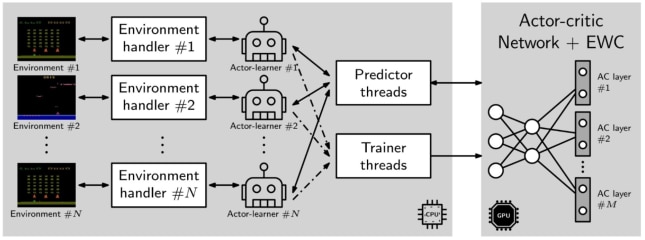
1This project investigates two hypothesis regarding the use of deep reinforcement learning in multiple tasks. The first hypothesis is driven by the question of whether a deep reinforcement learning algorithm, trained on two similar tasks, is able to outperform two single-task, individually trained algorithms, by more efficiently learning a new, similar task, that none of the three algorithms has encountered before. The second hypothesis is driven by the question of whether the same multi-task deep RL algorithm, trained on two similar tasks and augmented with elastic weight consolidation (EWC), is able to retain similar performance on the new task, as a similar algorithm without EWC, whilst being able to overcome catastrophic forgetting in the two previous tasks. We show that a multi-task Asynchronous Advantage Actor-Critic (GA3C) algorithm, trained on Space Invaders and Demon Attack, is in fact able to outperform two single-tasks GA3C versions, trained individually for each single-task, when evaluated on a new, third task—namely, Phoenix.
We also show that, when training two trained multi-task GA3C algorithms on the third task, if one is augmented with EWC, it is not only able to achieve similar performance on the new task, but also capable of overcoming a substantial amount of catastrophic forgetting on the two previous tasks.
Andra projekt 3

Utbildning


Sluta bläddra.
Få matchad snabbare.
Prata med en expert och få skräddarsydda matchningar från vårt nätverk på bara 2 dagar.
Tillgång till över 6 000+ experter
Hitta en utvecklare i genomsnitt 2 dagar
Anställ snabbt och enkelt med 94% matchningsframgång