"I would really recommend working with Proxify when you're building a product, whether that's building a completely new team or scaling an existing one. Proxify has all the right talents for it."


Europe's largest vetted tech talent network
Stop wasting time and money on bad hires and focus on building great products. We match you with the top 1% of Elixir freelance developers, consultants, engineers, programmers and experts in days, not months.
ISO 27001
Certified

Proxify has matched Elixir developers to companies across more than 2,500 engagements worldwide — from early-stage startups to enterprises including Lufthansa, PwC, and Education First. That track record is built on one thing: a vetting process that accepts only around 1% of applicants and a matching process that delivers a 94% success rate.
Every Elixir developer in our network has cleared five independent rounds of evaluation: AI-powered screening, English assessment, technical assessment, HR and soft skills interview, and a live technical interview with senior engineers. By the time a developer appears in your shortlist, they've already proven they can do the job — not just describe it.
Getting started is straightforward. You share your requirements in a 25-minute call. Within an average of 2 days, you receive a curated selection of hand-picked Elixir developers matched to your stack, team, and timeline. There's no commitment until you approve a match, and no lock-in after you start. If the engagement goes well, you can transition the developer to your own payroll at any point.
Hire fast with Proxify
The ultimate hiring guide: find and hire a top Elixir Expert
We combine the best of AI-technology and our team’s deep expertise to deliver hand-picked talent in just a few days.
Get started in just three simple steps.
1

Share your unique context with us over a 25-minute call, so we can match you with the perfect candidates for your needs.
2
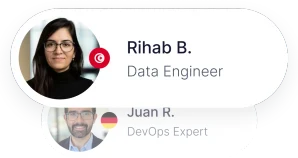
After an average of 2 days, receive a selection of hand-picked, ready-to-work specialists, with direct access to booking a call to interview them.
3
Integrate your new team members in 2 weeks or less. We’ll handle HR and admin, so you don’t lose momentum.
Hire top-tier, vetted talent. Fast.


"I would really recommend working with Proxify when you're building a product, whether that's building a completely new team or scaling an existing one. Proxify has all the right talents for it."


"We can trust Proxify to select good engineers that can help us speed up the process."


"The candidates coming in from Proxify are top-notch individuals."
Skip the resume pile. Our network represents the elite 1% of Elixir developers worldwide, across 1,000+ tech competencies, with an average of eight years of experience—meticulously vetted and instantly available.

"Quality is at the core of what we do. Our in-depth assessment process ensures that only the top 1% of developers join the Proxify network, so our clients always get the best talent available."
Stoyan Merdzhanov
VP Assessment

Rafael Weiss
Client Engineer


 +40
+40 Takes the time to thoroughly understand your technical challenges. With their expertise, you get the best-fit professionals, ready to solve your toughest challenges on your roadmap, fast.

Matthew Moroni
Client Manager US
Your long-term partner, offering personal support in onboarding, HR and admin to manage your Proxify developers.
Finding the right Elixir developers can make a huge difference for companies looking to build reliable, high-performance applications. Thanks to its fault-tolerant design and efficient concurrency model, the demand for Elixir continues to grow, making finding top talent a critical priority and a challenge for many organizations.
Whether expanding your team or starting a new project that relies on Elixir's strengths, knowing how to attract, assess, and secure the best talent is essential.
Elixir is a functional, concurrent programming language built on the Erlang VM (BEAM). It is known for its scalability and fault tolerance and is widely used for building distributed real-time applications. Inspired by Ruby, its syntax offers simplicity and readability, making it an appealing option for developers who manage large systems with minimal complexity.
Elixir has grown in popularity, particularly in industries that require high-availability systems, such as telecommunications, fintech, and eCommerce. As businesses shift toward microservices and distributed architectures, Elixir has emerged as a competitive skill, offering a solid foundation for developers and companies alike.
Investing in Elixir expertise allows companies to create reliable, scalable, and maintainable systems. This makes it a smart choice for organizations building robust applications in a competitive marketplace.
Elixir is widely used in various industries due to its strengths in handling concurrency, fault tolerance, and real-time processing. Here are a few key areas where Elixir excels:
Elixir offers a competitive advantage by allowing companies to build distributed, resilient, scalable systems while minimizing the complexity traditionally associated with such architectures.
When hiring Elixir developers, evaluating them on a set of core technical skills fundamental to the language and its ecosystem is essential. These skills directly impact the quality, scalability, and reliability of the software your team builds.
A deep understanding of Elixir syntax, core libraries, and functional programming paradigms is the foundation of effective Elixir development. Elixir is built on functional programming principles, which promote immutability, higher-order functions, and recursion. Developers who are proficient in these paradigms can write more predictable, maintainable, and bug-resistant code.
Elixir runs on the Erlang Virtual Machine (BEAM), renowned for its ability to handle massive concurrency, fault tolerance, and distributed computing. Developers familiar with BEAM can leverage its strengths to build highly available and performable applications under heavy load.
Elixir's concurrency model is one of its standout features, making it ideal for applications that require high levels of parallel processing. Developers must understand how to effectively use lightweight processes, GenServer, and Supervisors to manage these processes, ensuring your applications remain fault-tolerant and responsive.
Phoenix is Elixir's go-to framework for building web applications, APIs, and real-time systems. Developers with Phoenix expertise can craft high-performance web applications that take full advantage of Elixir's concurrency and scalability features.
OTP is a collection of libraries and design principles for building fault-tolerant, distributed systems. Mastery of OTP allows developers to structure their applications to maximize uptime, reliability, and recovery from failures. OTP provides the building blocks for supervision trees, automatically restarting failed processes and making it easier to design resilient systems.
Elixir applications often interact with databases like PostgreSQL, MySQL, or MongoDB, and developers must have experience integrating these databases into the Elixir ecosystem. A solid understanding of Ecto, Elixir's database wrapper and query generator, is essential for building efficient, reliable database interactions.
In addition to core skills, these additional abilities can help set an exceptional Elixir developer apart:
Experience building distributed systems using tools like Kubernetes or Docker adds a valuable layer of expertise to an Elixir developer's skill set. While Elixir is designed for concurrency and fault-tolerance, container orchestration tools like Kubernetes and Docker provide the infrastructure to manage and deploy distributed applications at scale.
A developer proficient in these tools can effectively leverage Elixir's strengths across distributed environments, ensuring seamless scalability and more efficient resource management.
Knowledge of GraphQL and its integration with Elixir is a highly sought-after skill for API development. GraphQL, with its flexible querying capabilities, offers developers a powerful way to interact with APIs, providing more efficiency than traditional REST.
Familiarity with Absinthe, the primary Elixir library for GraphQL, can help developers integrate and build GraphQL APIs efficiently within the Elixir ecosystem.
When combined with Elixir, developers can build performant, real-time APIs that handle large volumes of data with less overhead. This is particularly useful in applications requiring complex querying logic or real-time data updates, making the integration of GraphQL a great asset for enhancing the performance and flexibility of your services.
Experience with Phoenix Channels is another nice-to-have skill that distinguishes top Elixir developers. Phoenix Channels are a core part of Elixir's web framework, enabling developers to build real-time features such as live updates, chat systems, or collaborative tools with minimal effort.
Mastery of this technology allows developers to push updates to users in real-time without relying on constant polling or external services, which can lead to more interactive and responsive user experiences.
When hiring an Elixir developer, it's advantageous if candidates have experience with related languages such as Clojure, Ruby, or Erlang. These languages share key similarities with Elixir in terms of paradigms and functionality.
Understanding how to optimize Elixir applications for speed and scalability is critical for developers working with large-scale systems. This skill includes using benchmarking tools to identify bottlenecks, tuning the BEAM for better performance, and improving process scheduling to handle higher loads more efficiently.
Developers who can optimize Elixir's execution environment will write applications that perform better under heavy traffic or computational load, delivering smooth and responsive services even in resource-constrained conditions.
Familiarity with microservices design patterns is another desirable skill, especially as more organizations shift toward distributed systems. Elixir's lightweight processes and concurrency model make it well-suited for microservices architecture.
Developers with experience designing and managing microservices can fully utilize Elixir’s scalability and reliability, ensuring each service remains independent, easy to scale, and fault-tolerant.
Testing is a crucial part of software development, and experience with frameworks such as ExUnit for unit testing, property-based, and integration testing can set a developer apart. Developers skilled in these areas will ensure their code is reliable, maintainable, and free from regressions.
This results in fewer production bugs and a more stable application overall. Testing skills reflect a commitment to code quality, which is essential for delivering robust applications that can evolve with changing business needs.
Below are a few interview questions you can use to assess an Elixir developer's skills:
1. What are the key differences between Elixir and Erlang?
Example answer: Elixir provides a more modern syntax inspired by Ruby and includes better tooling (such as Mix). However, both run on the same virtual machine (BEAM), meaning they share the same concurrency and fault-tolerance features.
2. Explain the role of the Erlang VM (BEAM) in Elixir applications.
Example answer: The BEAM enables Elixir to support lightweight processes, making it highly concurrent, fault-tolerant, and capable of running distributed systems. It's key to Elixir's ability to manage thousands of processes efficiently.
3. What is OTP, and how does it relate to Elixir?
Example answer: OTP (Open Telecom Platform) is a set of Erlang libraries and design principles for building scalable, fault-tolerant applications. Elixir developers use OTP to handle concurrency, state management, and error recovery.
4. What are GenServer and Supervisors, and how do they work together?
Example answer: GenServer is a generic server that abstracts common client-server interactions, while Supervisors are processes that monitor other processes and ensure they restart if they fail. Together, they form the backbone of Elixir's fault tolerance.
5. How does Elixir handle concurrency?
Example answer: Elixir uses lightweight processes that run concurrently within the BEAM. Processes communicate via message passing, allowing highly concurrent operations without traditional locking or shared state issues.
6. Describe how Phoenix Channels work for real-time communication.
Example answer: Phoenix Channels allow real-time bi-directional communication between clients and the server, leveraging WebSockets. They are used for features like live updates, chats, and online collaboration.
7. How do you handle state in an Elixir application?
Example answer: State in Elixir is typically managed using GenServer processes. These processes maintain state across calls and can be restarted by Supervisors if they crash, ensuring reliability.
8. What strategies would you use to scale an Elixir application?
Example answer: Horizontal scaling using distributed Elixir nodes, employing Supervisors for process monitoring, and optimizing the system by minimizing bottlenecks and load-balancing across nodes.
9. Explain how pattern matching works in Elixir.
Example answer: Pattern matching allows for the matching of complex data structures based on shape and content. It is used extensively in function heads, case expressions, and clauses to simplify code and manage flow control.
10.vHow would you test an Elixir application?
Example answer: Testing in Elixir is commonly done with ExUnit for unit tests and tools like Ecto for database testing. Advanced developers may be familiar with tools like PropCheck or StreamData for property-based testing.
Elixir is a powerful language built for concurrency, scalability, and reliability—perfect for companies developing real-time, distributed systems. Investing in Elixir gives you a strong and flexible framework for building applications that need to handle high traffic and complex operations.
When looking for Elixir developers, focus on key technical skills like Elixir proficiency, knowledge of the BEAM, and experience with Phoenix and OTP. Bonus skills like expertise in distributed systems, performance tuning, and microservices architecture can help you find exceptional candidates.
With this guide, you'll be ready to identify top Elixir talent and build a team capable of tackling even the most demanding projects.
Hiring a Elixir developers?
Hand-picked Elixir experts with proven track records, trusted by global companies.
We work exclusively with top-tier professionals. Our writers and reviewers are carefully vetted industry experts from the Proxify network who ensure every piece of content is precise, relevant, and rooted in deep expertise.

Abdelraheem Jaradat
Full stack (BE heavy) Engineer
Abdelraheem is a seasoned Full Stack Engineer with over nine years of experience, specializing in backend development using JavaScript, Node.js, React.js, and AWS. With deep expertise in building and scaling web applications, he has a proven track record of managing CI/CD pipelines using Jenkins and delivering high-performance, scalable backend systems and real-time applications. Beyond his engineering work, Abdelraheem has been an ACM ICPC judge and problem-setter, reflecting his dedication to the software development community.


Trusted by 2,500 global companies