"I would really recommend working with Proxify when you're building a product, whether that's building a completely new team or scaling an existing one. Proxify has all the right talents for it."

Europe's largest vetted tech talent network
Hire senior and proven NLP developers
Stop wasting time and money on bad hires and focus on building great products. We match you with the top 1% of NLP freelance developers, consultants, engineers, programmers and experts in days, not months.
ISO 27001
Certified
Hire NLP developers fast with Proxify
Proxify helps companies hire vetted NLP developers quickly and with less risk. We have matched tech professionals with startups and global enterprises such as Lufthansa, PwC, and Education First, among others. Only around 1% of applicants join our network, and 94% of introduced candidates are successfully matched.
Every NLP developer completes five vetting stages, including AI-powered screening, English and technical assessments, a soft skills interview, and a live technical interview with senior engineers.
After a 25-minute discovery call, you receive a hand-picked shortlist of NLP developers within an average of 2 days. There is no commitment until you approve a match, no long-term lock-in, and the option to move the developer to your own payroll.
Hire fast with Proxify
Role:
Machine Learning
Type:
Other
Current demand:
Low
Proxify rate:
From $33.90/hr
Get matched in 2 days
Hire with 94% match success
Talk to a NLP hiring expert today
The ultimate hiring guide: find and hire a top NLP Expert
Talented NLP developers available now

Traian V.
Machine Learning Engineer
Romania
Trusted member since 2025
6 years of experience
Traian is a Senior Machine Learning Engineer with over seven years of commercial experience delivering AI solutions across customer support automation, computer vision, natural language processing, and generative AI.
Expert in

Georgios B.
Lead AI Engineer
Greece
Trusted member since 2026
10 years of experience
Georgios is a Lead Machine Learning Engineer with over 10 years of commercial experience designing and deploying production AI systems, specializing in Natural Language Processing (NLP), Large Language Models (LLMs), and Generative AI. He holds a PhD in NLP focused on LLM fine-tuning and modern transformer architectures and has published research in Springer, IEEE, and IFIP.
Expert in

Roberto N.
Machine Learning Engineer
Portugal
Trusted member since 2023
15 years of experience
Roberto is a seasoned Machine Learning Engineer with over a decade of commercial experience spanning data science, machine learning, cloud computing, and software engineering.
Expert in

Miguel A.
Data Scientist
Spain
Trusted member since 2025
7 years of experience
Miguel is an accomplished AI Engineer with seven years of hands-on, commercial experience architecting and deploying AI/ML solutions using Python, Apache Spark, Azure ML, and Databricks.
Expert in

Emil A.
Data Scientist
Azerbaijan
Trusted member since 2022
5 years of experience
Emil is an accomplished Data Scientist and PhD.C. with four years of experience in the IT sector, mainly working on Machine Learning, Research, Statistics, and Data Tools.
Expert in

Farid H.
Machine Learning Engineer
Azerbaijan
Trusted member since 2023
6 years of experience
Farid is a skilled Machine Learning Engineer with a history of working in various tech companies and research projects.
Expert in

Levon Y.
Senior ML Engineer
Portugal
Trusted member since 2026
8 years of experience
A Senior Machine Learning Engineer with over seven years of commercial experience designing, developing, and deploying production-grade Machine Learning solutions across fraud detection, natural language processing (NLP), computer vision, document intelligence, and large language model (LLM) applications.
Expert in

Oguz K.
Data Scientist
Turkey
Trusted member since 2023
5 years of experience
Oguz is a seasoned Data Science professional with five years of commercial experience and strong Python and Data Science proficiency.
Expert in

Aniello P.
Data Engineer
Italy
Trusted member since 2025
7 years of experience
Aniello is a Senior Data Engineer with over seven years of commercial experience developing data-driven, production-grade systems. He specializes in software and machine learning pipeline development using Python, Azure, Databricks, and distributed computing frameworks.
Expert in

Giorgi B.
Data Scientist
Georgia
Trusted member since 2023
6 years of experience
Giorgi is a seasoned Senior Data Scientist with six years of experience, specializing in HR technology, cloud-based POS systems, SaaS, cloud computing, eCommerce, and AI technology.
Expert in

Omer A.
Data Scientist
Turkey
Trusted member since 2022
6 years of experience
Omer is a highly skilled Data Scientist and Machine Learning Engineer with over four years of experience in research and development. His expertise spans various domains, including LLMs, NLP, Reinforcement Learning, Time Series Forecasting, Medical Imaging, and end-to-end Machine Learning Systems architecture.
Expert in

João M.
Deep Learning Research Engineer
Netherlands
Trusted member since 2025
10 years of experience
João is a Deep Learning Engineer at ASML with over 10 years of experience in artificial intelligence.
Expert in
Traian V.
Machine Learning Engineer
Romania
Trusted member since 2025
6 years of experience
Traian is a Senior Machine Learning Engineer with over seven years of commercial experience delivering AI solutions across customer support automation, computer vision, natural language processing, and generative AI.
Expert in
NLP
Python
Machine Learning
Data Science
Computer Vision
The ultimate hiring guide: find and hire a top NLP Expert
Three steps to your perfect NLP developer
We combine the best of AI-technology and our team’s deep expertise to deliver hand-picked talent in just a few days.
Get started in just three simple steps.
1
Book a meeting
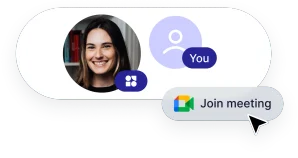
Share your unique context with us over a 25-minute call, so we can match you with the perfect candidates for your needs.
2
Review your matches
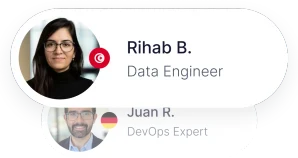
After an average of 2 days, receive a selection of hand-picked, ready-to-work specialists, with direct access to booking a call to interview them.
3
Start working together
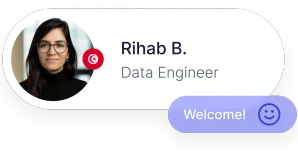
Integrate your new team members in 2 weeks or less. We’ll handle HR and admin, so you don’t lose momentum.
Find NLP developers
Hire top-tier, vetted talent. Fast.
Why clients trust Proxify


"We can trust Proxify to select good engineers that can help us speed up the process."


"The candidates coming in from Proxify are top-notch individuals."
Only senior professionals, extensively vetted
Skip the resume pile. Our network represents the elite 1% of NLP developers worldwide, across 1,000+ tech competencies, with an average of eight years of experience—meticulously vetted and instantly available.
Application process
Our vetting process is one of the most rigorous in the industry. Over 20,000 developers apply each month to join our network, but only about 1% make it through. When a candidate applies, they’re evaluated through our Applicant Tracking System. We consider factors like years of experience, tech stack, rates, location, and English proficiency.
Screening interview
The candidates meet with one of our recruiters for an intro interview. This is where we dig into their English proficiency, soft skills, technical abilities, motivation, rates, and availability. We also consider our supply-demand ratio for their specific skill set, adjusting our expectations based on how in-demand their skills are.
Assessment
Next up, the candidate receives an assessment; this test focuses on real-world coding challenges and bug fixing, with a time limit to assess how they perform under pressure. It’s designed to reflect the kind of work they’ll be doing with clients, ensuring they have the necessary expertise.
Live coding
Candidates who pass the assessment move on to a technical interview. This interview includes live coding exercises with our senior engineers, during which they're presented with problems and need to find the best solutions on the spot. It’s a deep dive into their technical skills, problem-solving abilities, and thinking through complex issues.
Proxify member
When the candidate impresses in all the previous steps, they’re invited to join the Proxify network.

"Quality is at the core of what we do. Our in-depth assessment process ensures that only the top 1% of developers join the Proxify network, so our clients always get the best talent available."
Stoyan Merdzhanov
VP Assessment
Meet your dedicated dream team

Rafael Weiss
Client Engineer


 +40
+40 Takes the time to thoroughly understand your technical challenges. With their expertise, you get the best-fit professionals, ready to solve your toughest challenges on your roadmap, fast.

Matthew Moroni
Client Manager US
Your long-term partner, offering personal support in onboarding, HR and admin to manage your Proxify developers.
A guide to help you hire NLP Developers in 2025
Industries and applications
Natural Language Processing (NLP) is a rapidly evolving subfield of artificial intelligence that focuses on enabling machines to understand, interpret, and generate human language. From virtual assistants and chatbots to text analytics and sentiment analysis, NLP powers many of the AI-driven technologies we interact with daily.
In 2025, demand for NLP developers will continue to grow as businesses increasingly rely on data from human communication, text, voice, chat, and more. What used to take teams months to implement (e.g., sentiment analysis) now takes one engineer weeks using an LLM. Hiring skilled NLP developers is essential for building intelligent applications that can extract value from unstructured language data while maintaining performance, scalability, and ethical alignment.
Industries and applications
NLP's versatility enables its application across a wide range of industries:
- Customer experience (CX): Drives chatbots, ticket classification, and sentiment analysis in multi-channel support systems.
- Healthcare: Extracting information from clinical notes, automating diagnostics, or assisting in patient communication via voice bots.
- Finance: Automating customer support, fraud detection through transactional text, and analysing earnings reports.
- eCommerce: Powering intelligent search, product recommendations, and sentiment-driven marketing.
- Legal & compliance: Document classification, contract parsing, and regulatory text monitoring.
- Education: Intelligent tutoring systems, automated essay grading, and language learning platforms.
- Media & publishing: Supports article summarisation, moderation, metadata tagging, and recommendation engines.
NLP can benefit any business that works with textual data, such as emails, support tickets, product reviews, legal documents, and more.
Must-have skills for NLP Developers
To build robust NLP solutions, top developers typically possess the following core competencies:
- Strong Python skills with experience in NLP libraries such as NLTK, spaCy, Hugging Face Transformers, or AllenNLP.
- Deep understanding of language modeling (e.g., BERT, GPT, T5) and familiarity with fine-tuning transformer-based models for downstream tasks.
- Experience with classical NLP techniques, such as tokenization, lemmatization, POS tagging, dependency parsing, and named entity recognition.
- Machine learning fundamentals, including model evaluation, feature engineering, and cross-validation.
- Text vectorization techniques including word embeddings (Word2Vec, GloVe) and contextual embeddings.
- Data wrangling and preprocessing using pandas, regex, and language-specific techniques for cleaning noisy real-world data.
- Deployment skills, including building NLP APIs with FastAPI or Flask and packaging models for production.
- Familiarity with ethical AI, including bias mitigation, explainability in language models, and data privacy considerations.
Nice-to-have skills
While not mandatory, the following skills can set candidates apart:
- Multilingual NLP experience or work with low-resource languages.
- Knowledge of LLM frameworks and prompt engineering, particularly for GPT-style inference.
- Experience integrating NLP with speech (ASR/TTS) using tools like Whisper, DeepSpeech, or Coqui TTS.
- MLOps skills include versioning (DVC), monitoring (Evidently AI), and model registry tools (MLflow).
- Data annotation and augmentation techniques using Snorkel or Prodigy.
- Working with vector databases (e.g., Pinecone, Weaviate) for semantic search or RAG (Retrieval Augmented Generation) pipelines.
Interview questions and example answers
1. What is tokenisation, and why is it important in NLP?
Example answer: Tokenisation is the process of splitting text into smaller units such as words, subwords, or sentences. It is a fundamental step in NLP as it structures unstructured text for further processing, such as parsing, classification, or embedding.
2. How would you fine-tune a BERT model for sentiment analysis?
Example answer: I’d use a labelled dataset with sentiment tags, tokenise it using BERT's tokeniser, add a classification head, and fine-tune using a cross-entropy loss. I'd monitor validation accuracy and apply early stopping or learning rate scheduling as needed.
3. How do you evaluate an NLP classification model?
Example answer: Common metrics include accuracy, precision, recall, and F1-score. For imbalanced datasets, precision-recall AUC or ROC AUC are more informative. I also examine confusion matrices and error analysis to understand misclassifications.
4. What are some techniques to handle out-of-vocabulary (OOV) words?
Example answer: Using subword tokenisation (e.g., Byte Pair Encoding) helps handle OOVs. Alternatively, using contextual embeddings like BERT eliminates the need for fixed vocabularies.
5. What are the ethical challenges in deploying NLP models?
Example answer: NLP models can exhibit gender, racial, or political biases learned from training data. To mitigate harm, it’s crucial to perform fairness audits, use debiasing methods, and ensure transparency about model limitations.
6. What are Retrieval-Augmented Generation (RAG) pipelines, and when are they useful?
Example answer: RAG combines document retrieval with generation by augmenting the input to a language model with relevant documents. It improves factual accuracy and reduces hallucinations in tasks like QA, summarization, or enterprise search.
7. How do you handle class imbalance in text classification tasks?
Example answer: I’d use strategies like resampling (oversampling minority, undersampling majority), weighted loss functions, or generating synthetic samples (e.g., with back-translation). Evaluation metrics like precision, recall, and AUC are more appropriate than accuracy.
8. What are the advantages of using Transformer-based models over RNNs or LSTMs?
Example answer: Transformers enable parallel processing and capture long-range dependencies via self-attention, making them more efficient and effective on large-scale text. They’ve largely replaced RNNs/LSTMs in modern NLP tasks like translation, summarization, and question answering.
9. How would you implement Named Entity Recognition (NER) for a custom domain?
Example answer: I’d start with an existing model like spaCy or fine-tune a transformer like BERT on annotated data for the domain. If labeled data is scarce, I’d use weak supervision or transfer learning, and evaluate using F1-score on entity-level spans.
10. What is the difference between stemming and lemmatization, and when would you use each?
Example answer: Stemming crudely chops word endings (e.g., “running” → “run”) and may produce non-words. Lemmatization uses vocabulary and morphology to return base forms (e.g., “better” → “good”). Use stemming for speed in large-scale search; lemmatization for precision in tasks like information extraction.
Summary
Hiring NLP developers in 2025 means looking beyond just technical know-how. A great candidate combines linguistic intuition with deep AI expertise, production-level coding skills, and an awareness of ethical implications.
As language data grows in strategic importance, companies need NLP developers to transform it into actionable insights through search, summarization, classification, or generation. By screening for the right mix of hard and soft skills, businesses can build NLP teams that drive innovation, user satisfaction, and intelligent automation at scale.
Hiring a NLP developers?
Find NLP developers
Hand-picked NLP experts with proven track records, trusted by global companies.
Verified author
We work exclusively with top-tier professionals. Our writers and reviewers are carefully vetted industry experts from the Proxify network who ensure every piece of content is precise, relevant, and rooted in deep expertise.

Emil Aydinsoy
Data Scientist and Engineer
Emil is an accomplished Data Scientist and Ph.D. with five years of commercial experience in the IT sector, mainly working on Machine Learning, Research, Statistics, and Data Engineering Tools
Related articles
Have a question about hiring a NLP developer?
Explore more skills
Role
Software product engineering
Data and artificial Intelligence
Cloud and infrastructure
Quality Assurance
Design
Trusted by 2,500 global companies