"I would really recommend working with Proxify when you're building a product, whether that's building a completely new team or scaling an existing one. Proxify has all the right talents for it."

Europe's largest vetted tech talent network
Hire senior and proven ElasticSearch developers
Stop wasting time and money on bad hires and focus on building great products. We match you with the top 1% of ElasticSearch freelance developers, consultants, engineers, programmers and experts in days, not months.
ISO 27001
Certified

Hire ElasticSearch developers fast with Proxify
Proxify helps companies hire vetted ElasticSearch developers quickly and with less risk. We have matched tech professionals with startups and global enterprises such as Lufthansa, PwC, and Education First, among others. Only around 1% of applicants join our network, and 94% of introduced candidates are successfully matched.
Every ElasticSearch developer completes five vetting stages, including AI-powered screening, English and technical assessments, a soft skills interview, and a live technical interview with senior engineers.
After a 25-minute discovery call, you receive a hand-picked shortlist of ElasticSearch developers within an average of 2 days. There is no commitment until you approve a match, no long-term lock-in, and the option to move the developer to your own payroll.
Hire fast with Proxify
Role:
Backend
Type:
Database
Current demand:
Low
Proxify rate:
From $33.90/hr
Get matched in 2 days
Hire with 94% match success
Talk to a ElasticSearch hiring expert today
The ultimate hiring guide: find and hire a top ElasticSearch Expert
Talented ElasticSearch developers available now

Andrey K.
PHP Developer
Bulgaria
Trusted member since 2019
12 years of experience
Andrii has over 8 years of professional experience in development and extensive knowledge in Backend and Frontend development and other programming languages.
Expert in

Edison X.
Ruby on Rails Developer
Kosovo
Trusted member since 2022
7 years of experience
Edison is an accomplished web developer with strong Ruby on Rails knowledge who has worked in the information technology and services industry for over seven years.
Expert in

Tomek J.
Fullstack Developer
Poland
Trusted member since 2022
17 years of experience
Tomek is a Fullstack developer with over 17 years of commercial experience. Over the years, he has transitioned from PHP to mastering modern tech stacks, with a focus on Vue.js and Node.js in the last six years. His expertise in these technologies has been instrumental in developing and supporting robust, high-traffic systems.
Expert in

Arek P.
Senior Backend Developer
Poland
Trusted member since 2026
11 years of experience
Arek is a Backend Developer with over 10 years of commercial experience building scalable, domain-driven backend systems for fuel logistics, payments, and SaaS platforms. He specializes in Ruby on Rails, PostgreSQL, REST API design, and production-safe refactoring, with extensive experience designing complex, data-intensive applications.
Expert in

Andrei L.
Fullstack Developer
Romania
Trusted member since 2025
15 years of experience
Andrei is a seasoned fullstack developer with over 15 years of commercial experience, specializing in PHP frameworks such as Laravel and Yii, and JavaScript technologies including Node.js, React, and Vue.js. His database expertise covers both SQL (MySQL, PostgreSQL, MariaDB) and NoSQL (Redis, Elasticsearch) systems.
Expert in

Konrad K.
Azure Engineer
Hungary
Trusted member since 2025
5 years of experience
Konrad is an Azure Engineer with over five years of hands-on experience in DevOps and Site Reliability Engineering (SRE). He specializes in Terraform, infrastructure as code (IaC), EKS/ArgoCD, CI/CD pipelines, Ansible, Docker/Helm, scripting, and monitoring/logging.
Expert in

Rinon B.
Ruby on Rails Developer
Germany
Trusted member since 2022
8 years of experience
Rinon is a Backend-heavy Fullstack developer with nine years of commercial experience, focusing on Ruby on Rails and JavaScript.
Expert in

Alireza T.
DevOps Engineer
Georgia
Trusted member since 2024
7 years of experience
Alireza is a DevOps Engineer with over 10 years of experience, specializing in AWS, Linux, Kubernetes, and Terraform. He’s also skilled in Python and Bash scripting, always eager to solve problems and explore new tools.
Expert in
Andrey K.
PHP Developer
Bulgaria
Trusted member since 2019
12 years of experience
Andrii has over 8 years of professional experience in development and extensive knowledge in Backend and Frontend development and other programming languages.
Expert in
ElasticSearch
PHP
JavaScript
Symfony
Yii
The ultimate hiring guide: find and hire a top ElasticSearch Expert
Three steps to your perfect ElasticSearch developer
We combine the best of AI-technology and our team’s deep expertise to deliver hand-picked talent in just a few days.
Get started in just three simple steps.
1
Book a meeting

Share your unique context with us over a 25-minute call, so we can match you with the perfect candidates for your needs.
2
Review your matches
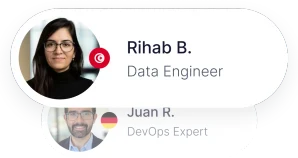
After an average of 2 days, receive a selection of hand-picked, ready-to-work specialists, with direct access to booking a call to interview them.
3
Start working together
Integrate your new team members in 2 weeks or less. We’ll handle HR and admin, so you don’t lose momentum.
Find ElasticSearch developers
Hire top-tier, vetted talent. Fast.
Why clients trust Proxify


"We can trust Proxify to select good engineers that can help us speed up the process."


"The candidates coming in from Proxify are top-notch individuals."
Only senior professionals, extensively vetted
Skip the resume pile. Our network represents the elite 1% of ElasticSearch developers worldwide, across 1,000+ tech competencies, with an average of eight years of experience—meticulously vetted and instantly available.
Application process
Our vetting process is one of the most rigorous in the industry. Over 20,000 developers apply each month to join our network, but only about 1% make it through. When a candidate applies, they’re evaluated through our Applicant Tracking System. We consider factors like years of experience, tech stack, rates, location, and English proficiency.
Screening interview
The candidates meet with one of our recruiters for an intro interview. This is where we dig into their English proficiency, soft skills, technical abilities, motivation, rates, and availability. We also consider our supply-demand ratio for their specific skill set, adjusting our expectations based on how in-demand their skills are.
Assessment
Next up, the candidate receives an assessment; this test focuses on real-world coding challenges and bug fixing, with a time limit to assess how they perform under pressure. It’s designed to reflect the kind of work they’ll be doing with clients, ensuring they have the necessary expertise.
Live coding
Candidates who pass the assessment move on to a technical interview. This interview includes live coding exercises with our senior engineers, during which they're presented with problems and need to find the best solutions on the spot. It’s a deep dive into their technical skills, problem-solving abilities, and thinking through complex issues.
Proxify member
When the candidate impresses in all the previous steps, they’re invited to join the Proxify network.

"Quality is at the core of what we do. Our in-depth assessment process ensures that only the top 1% of developers join the Proxify network, so our clients always get the best talent available."
Stoyan Merdzhanov
VP Assessment
Meet your dedicated dream team

Rafael Weiss
Client Engineer


 +40
+40 Takes the time to thoroughly understand your technical challenges. With their expertise, you get the best-fit professionals, ready to solve your toughest challenges on your roadmap, fast.

Matthew Moroni
Client Manager US
Your long-term partner, offering personal support in onboarding, HR and admin to manage your Proxify developers.
A guide to help you hire Elasticsearch Developers
What is Elasticsearch?
Originally created to solve the need for fast, scalable search, Elasticsearch has since evolved into a real-time analytics and data engine used across industries, from eCommerce to cybersecurity, fintech to education.
But building on Elasticsearch requires more than spinning up a node and sending some JSON. It demands thoughtful data modeling, performance tuning, infrastructure design, and awareness of evolving capabilities like vector search.
Hiring the right Elasticsearch developer can mean distinguishing between a slow, unstable system and a blazing-fast product that delights users.
What is Elasticsearch?
Elasticsearch is a powerful open-source search and analytics engine, built on top of Apache Lucene. It allows you to index, search, and analyze large volumes of data while being fast, flexible, and in near real-time.
It works with JSON documents and provides a RESTful API. Unlike relational databases that are built for transactional consistency, Elasticsearch is designed for speed, distribution, and flexible querying.
At its core, Elasticsearch powers:
- Full-text search engines
- Log analytics systems (like ELK stack: Elasticsearch, Logstash, Kibana)
- Security monitoring (SIEM)
- eCommerce search and filters
- AI vector-based semantic search
When do you need an Elasticsearch Developer?
If your application needs lightning-fast search, real-time insights, or scalable filtering over big datasets, Elasticsearch is often the best tool for the job. Here are key signs you need an Elasticsearch expert:
- You’re building custom search functionality for users;
- You’re drowning in logs and need fast, structured analytics;
- You want real-time dashboards from large data feeds;
- Your app performance lags under search or filter load;
- You want to implement vector search or semantic AI querying.
What makes a great Elasticsearch Developer?
An Elasticsearch developer wears many hats—part backend engineer, part data architect, part performance analyst. Here are the core skills you should look for:
1. Query DSL mastery
Elasticsearch uses a JSON-based Domain-Specific Language (DSL) for querying. A good developer should write and optimize complex search queries like:
GET /products/_search
{
  "query": {
    "bool": {
      "must": [
        { "match": { "title": "wireless headphones" } },
        { "range": { "price": { "lte": 200 } } }
      ]
    }
  },
  "sort": [{ "rating": "desc" }]
}
They should also understand:
- Full-text search vs term queries
- Aggregations (for analytics)
-
Filters and boosting
2. Index design & data modeling
Unlike SQL databases, Elasticsearch requires a denormalized data structure. A skilled developer:
- Designs proper mappings (e.g. text vs keyword fields)
- Avoids nested pitfalls and over-indexing
- Knows when to use custom analyzers
Example mapping snippet:
PUT /users
{
  "mappings": {
    "properties": {
      "username": { "type": "keyword" },
      "bio": { "type": "text" },
      "signup_date": { "type": "date" }
    }
  }
}
3. Cluster architecture & scaling
Elasticsearch is distributed. A strong developer should understand:
- Shards, replicas, and node roles
- Load balancing and read/write strategies
- Cluster scaling, ILM (Index Lifecycle Management), rollover indices
4. Log ingestion pipelines
Many real-time systems ingest logs via:
- Logstash for complex pipelines with filters/parsing
- Beats (Filebeat, Metricbeat) for lightweight shippers
- Native Ingest Pipelines using processors (like grok, geoip, date)
PUT _ingest/pipeline/parse_logs
{
  "processors": [
    {
      "grok": {
        "field": "message",
        "patterns": ["%{COMMONAPACHELOG}"]
      }
    }
  ]
}
5. Kibana and visualization
Developers should be comfortable with:
- Building custom dashboards in Kibana
- Visualizing metrics, trends, and anomalies
- Writing alerts with Watcher or Kibana Alerting
6. Security & access controls
Enterprise Elasticsearch demands security.
Your developer should know:
- TLS/SSL setup
- RBAC (Role-Based Access Control)
- API keys & endpoint protections
- Secure cluster exposure via proxies
Nice-to-haves
- Familiarity with Elastic's k-NN plugin for vector search
- Experience with OpenSearch
- Using Painless scripts for custom scoring or data transformations
- CI/CD setup for cluster management (Ansible, Terraform)
- Docker/Kubernetes deployments for Elastic stacks
Common mistakes developers make with Elasticsearch
Even experienced engineers often make avoidable mistakes that hurt performance or reliability. Here are the top ones to watch for:
- Too many shards: Default settings often create 5 shards per index, which can overwhelm small clusters. Under-sharding is often better than over-sharding.
- Incorrect field mapping: Using text when keyword is needed breaks filters and aggregations; using keyword when text is needed prevents full-text search.
- No index lifecycle management (ILM): Without ILM, logs accumulate endlessly, leading to bloated indices and performance drop-offs.
- Unoptimized queries: Not using filters in bool queries leads to unnecessary scoring; not paginating properly causes memory issues.
- Missing monitoring: Ignoring /_cat APIs or stats endpoints means problems go unnoticed until it’s too late.
Sample interview questions (with real answers)
Q1. What’s the difference between text and keyword fields?
A: Text fields are analyzed and broken into terms, which is great for full-text search. Keyword fields store exact values, which is ideal for filtering, sorting, and aggregating.
Q2. How do you optimize Elasticsearch for growing data volume?
A: Use rollover indices + ILM to move data across hot/warm/cold tiers. Reduce shard count for small indices. For archived data, use force merge and slow refresh intervals.
Q3. How would you implement an autocomplete search?
A: Either using n-grams in a custom analyzer:
"analyzer": {
  "autocomplete": {
    "tokenizer": "edge_ngram",
    "filter": ["lowercase"]
  }
}
Or with a completion field:
"mappings": {
  "properties": {
    "suggest": { "type": "completion" }
  }
}
Q4. How would you secure your Elastic cluster?
A:
- TLS for internal and public traffic
- API Key auth for apps
- Access control via Elastic’s RBAC
- Avoid direct exposure—use a reverse proxy or VPC
Q5. What are the pros/cons of Elastic vs SQL?
A:
- Pros: Distributed, scalable, full-text search, real-time querying
- Cons: No joins, limited ACID compliance, more setup complexity
Q6. How do you handle partial updates to documents?
A: Use the _update API with a script or doc field to update only parts of a document—no need to reindex the entire doc.
Q7. What’s the role of analyzers in Elasticsearch?
A: Analyzers process text during indexing and searching. They consist of a tokenizer and filters—used to normalize text for accurate search matching.
Q8. How does Elasticsearch handle scaling?
A: It supports horizontal scaling via shards and replicas. You can add nodes to distribute load, improve fault tolerance, and speed up queries.
Q9. What is the difference between a filter and a query?
A: Queries calculate relevance scores and affect ranking. Filters are faster, cached, and used for boolean logic—ideal for structured fields.
Q10. How do you reindex data in Elasticsearch?
A: Use the _reindex API to copy documents from one index to another. This is useful for schema changes, merging indices, or applying new mappings.
How to future-proof your Elasticsearch implementation
Elasticsearch evolves rapidly. Here's how to keep your setup modern, scalable, and developer-friendly:
- Use managed services: Consider Elastic Cloud or OpenSearch Service for automatic scaling and maintenance.
- Implement vector search early: If your roadmap includes AI, start building indexes with semantic embeddings (via models like BERT).
- Monitor with Kibana & Alerts: Use built-in observability tools to catch issues proactively.
- Use ILM and rollover policies: Automate cold storage and archive strategies for older indices.
- Version lock and upgrade testing: Pin versions in dev/staging, and never blindly upgrade production clusters without compatibility checks.
How to future-proof your Elasticsearch implementation
Elasticsearch evolves rapidly. Here's how to keep your setup modern, scalable, and developer-friendly:
- Use managed services: Consider Elastic Cloud or OpenSearch Service for automatic scaling and maintenance.
- Implement vector search early: If your roadmap includes AI, start building indexes with semantic embeddings (via models like BERT).
- Monitor with Kibana & alerts: Use built-in observability tools to catch issues proactively.
- Use ILM and rollover policies: Automate cold storage and archive strategies for older indices.
- Version lock and upgrade testing: Pin versions in dev/staging, and never blindly upgrade production clusters without compatibility checks.
Common use cases by industry
eCommerce
Use case: Search by product title, brand, category, attributes, and filters Example: A fashion retailer like ASOS uses Elasticsearch to power fast, faceted product searches with autocomplete and price range filtering.
Healthcare
Use case: Patient record search and analytics across EHR systems Example: Hospitals use Elasticsearch to search by diagnosis codes, filter patients by age or treatment, and visualize health trends in Kibana.
Cybersecurity
Use case: Real-time threat detection and security event analysis Example: SIEM platforms ingest firewall and endpoint logs into Elasticsearch to detect brute-force attacks or generate security alerts instantly.
Media & news
Use case: Indexing articles, powering search, and content discovery Example: Publishers like BBC use Elasticsearch for real-time article search, tag filtering, and "related story" recommendations.
SaaS & tech
Use case: Unified search across app data, logs, and user content Example: SaaS tools like ClickUp use Elasticsearch to let users search across projects, messages, and documents with access control.
Red flags in Elasticsearch resumes
- Thinks in SQL terms – Tries to normalize data or mimic joins, showing a lack of document-oriented design thinking
- No mention of mappings or cluster setup – Likely used Elasticsearch passively, not as an architect or maintainer
- Overuses nested fields – Indicates a poor understanding of how nesting affects performance and query complexity
- Only references Kibana – Suggests reliance on visual tools without deeper knowledge of APIs or debugging methods
- No performance tuning experience – Absence of index, query, or cluster optimization under real-world load
Why hiring an Elasticsearch expert pays off
-
Better UX: Fast, accurate search responses lead to a smoother, more intuitive user experience—whether it’s product discovery, document search, or filtering large datasets.
-
Lower infrastructure costs: Skilled developers write efficient queries and optimize indexing, which reduces load on servers, cuts bandwidth usage, and avoids unnecessary hardware scaling.
-
Scalable architecture: Experts build with growth in mind—designing index strategies, shard distribution, and ILM policies that handle data expansion without performance degradation.
-
Security confidence: From access control to TLS encryption, experienced developers can secure Elasticsearch clusters properly—critical for compliance-heavy industries like finance and healthcare.
-
Innovative features: Elasticsearch is more than search—experts unlock capabilities like vector similarity, anomaly detection, autocomplete engines, and real-time alerting systems.
Hiring challenges
-
The learning curve is steep: Elasticsearch has its own query language, architectural patterns, and performance quirks—mastering it takes time and real-world experience.
-
Few developers understand cluster architecture deeply: Many developers use Elasticsearch, but few can configure clusters, tune shard allocation, or design node roles for resilience and speed.
-
Performance tuning is part science, part art: Optimizing for latency, throughput, and relevance involves benchmarking, fine-tuning queries, caching, and understanding how Lucene works under the hood.
-
Requires cross-tool expertise: Elasticsearch rarely runs alone; Logstash, Beats, Kibana, or even Kafka and Redis often come into play, demanding a broader systems mindset.
Summary: Invest in the right talent
Elasticsearch has redefined how businesses handle large-scale data search and analytics. With its flexible data model, distributed nature, and near real-time querying, it's a foundational technology in modern stacks.
This guide showed you how to identify when you need an Elasticsearch developer, what core skills to prioritize, how to assess candidates, and which industries benefit most from the platform. We also highlighted common mistakes to avoid and future-proofing tips to keep your setup efficient.
If you're building a product that thrives on fast, flexible, and secure data search, then Elasticsearch isn't optional, nor is hiring someone who truly knows how to use it right.
Hiring a ElasticSearch developers?
Find ElasticSearch developers
Hand-picked ElasticSearch experts with proven track records, trusted by global companies.
Verified author
We work exclusively with top-tier professionals. Our writers and reviewers are carefully vetted industry experts from the Proxify network who ensure every piece of content is precise, relevant, and rooted in deep expertise.

Mahmudul Hasan
DevOps Engineer
Mahmudul is a skilled DevOps Engineer with 8 years of experience, specializing in cloud deployment and SaaS platforms. He is proficient in AWS, Terraform, Ansible, Kubernetes, GCP, and Digital Ocean, enabling seamless infrastructure management and optimization.
Related articles
Have a question about hiring a ElasticSearch developer?
Explore more skills
Role
Software product engineering
Data and artificial Intelligence
Cloud and infrastructure
Quality Assurance
Design
Trusted by 2,500 global companies